
Online travel agencies (OTAs) that have a huge need for better travel payment processes seemed to be the most preferred choice for tourists. A recent research showed that out of approximately 2,000 travelers surveyed, a-third of them book directly, another one-third use travel agents, and more than 40% admit they prefer to use OTAs. Another research also reflected in the enormous market value, with the online travel sector expected to generate revenue of $1463.98 billion by 2027, up from over $800 billion in 2021.
The reason for the industry's potential is obvious: Like a "travel supermarket", OTAs give travelers more options, convenience, and security by letting them book flights, lodging, rentals, etc through a single provider and more importantly, a single point of payment. Unfortunately, OTAs have been paying a price for providing such value - the costs, risk, and complexity of managing the intricate networks of payments between suppliers and stakeholders on behalf of travelers became inevitably higher.
FinTechs, however, have the power to fundamentally change how funds flow within the travel ecosystem by giving OTAs more power, transparency, and understanding of travel payments. Let's see how OTAs can flourish with the right payment partner.
We can't do without travel agencies, whether we like it or not
Travel agencies have always played a significant role, even as travelers shift towards booking and planning for their own travel. Holidays and air travel involve a wide variety of parties, procedures, and locations; as global travel recovers from the COVID pandemic, OTAs continue to experience rising demand, post tumultuous times.
Challenges aplenty
For all other parties involved in the air travel process, such as airlines, hotels, rental companies, and others, OTAs act as a "melting pot" for booking, payment, and management. However, while travelers appreciates the ease of a single booking, OTAs must control a convoluted payment distribution process while juggling the razor-thin margins and commissions that are typical of the travel industry.
As we chat with some of our travel partners, these are some of the factors that impact profitability - payment costs, fraud, foreign exchange rates (FX), reconciliation, misalignment with partners and suppliers and many more.
Payments are becoming more and more crucial to the customer experience - to be successful, OTAs must approach payments holistically, balancing internal effectiveness, ecosystem connectivity, and customer experience.
Timely revolution - Virtual Commercial Cards (VCCs)
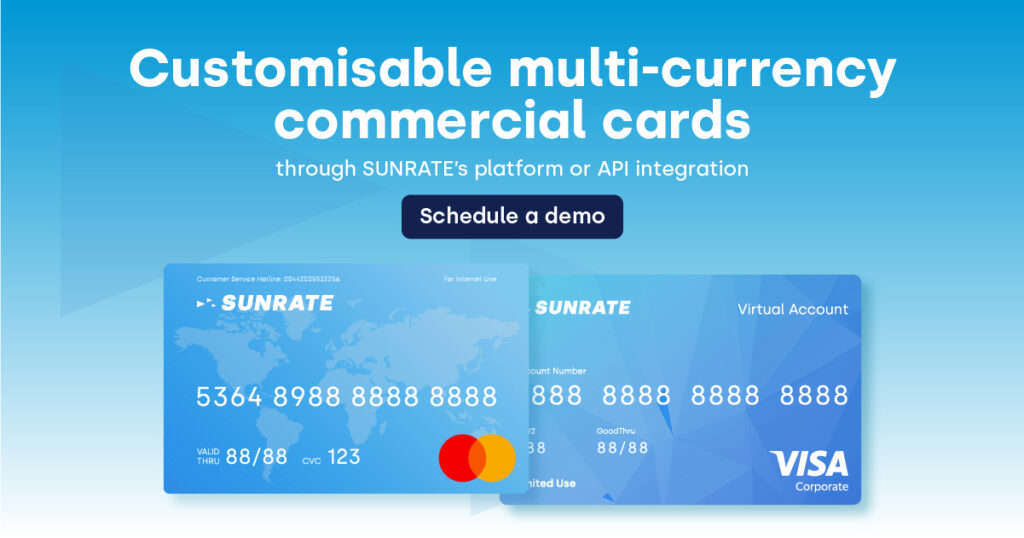
The use of virtual Commercial cards (VCCs) to control the payment process has been one of the most revolutionary developments in travel payments. With SUNRATE's online solutions, our virtual cards have proven their ability to innovate and provide peace of mind while processing travel payments:
It is also important to note that SUNRATE is certified to the international financial data security standard: Payment Card Industry Data Security Standard (PCI DSS) Level 1 and we are also the principal member of both Mastercard and Visa network.
Find out more about how SUNRATE can revolutionise travel payments for you by speaking with our travel specialist today. Or you can find us at ITB Berlin 2023 (hall 5.1 / exhibition booth 142b), happening at Messe Berlin , Singapore from 7 - 9 March 2023.
Share to


When e-commerce scaled in the early 2000s, the infrastructure providers that captured disproportionate value were not the ones with the most merchants or the most consumer relationships. They were the ones that built the payment rails, the fraud detection networks, and the settlement infrastructure that every merchant and every transaction depended on. The value flowed […]


The shift toward autonomous agentic commerce is reshaping how B2B platforms handle value movement, buyer-seller discovery, and transaction execution. While consumer commerce relies on quick UI friction reduction, B2B procurement operates on structured approvals, complex credit arrangements, multi-currency treasury constraints, and rigorous compliance standards. As enterprise AI agents evolve from read-only research tools into active commerce […]

Across enterprise procurement functions, a pattern is emerging that should concern every CFO, CPO, and Head of Compliance paying attention. AI procurement agents — deployed to automate supplier discovery, purchase order generation, invoice matching, and payment initiation — are operating in production environments where the governance frameworks that should define, constrain, and audit their behaviour have not yet been established. This […]
We hope to use cookies to better understand your use of this website. This will help improve your future experience of accessing this website. For detailed information on the use of cookies and how to revoke or manage your consent, please refer to our < privacy policy >. If you click the confirmation button on the right, you will be deemed to have agreed to use cookies.


