
FinTech payment service providers have experienced explosive growth and has disrupted the traditional banking and finance sectors in recent years. As a result, many businesses are now turning to FinTech companies to meet their business needs. This shift is driven by a range of factors, including the desire for faster, more efficient transactions, lower costs, and improved security. In this article, we will explore why businesses are making the switch to FinTech payment service providers (PSPs) and examine the key advantages that they offer.
The growth of FinTech
The growth of the FinTech industry has been nothing short of remarkable in recent years. Since the 2008 financial crisis, FinTech companies have emerged as disruptive challengers to traditional banks and financial institutions, offering faster, cheaper, and more user-friendly financial services. As a result, businesses across industries are increasingly turning to FinTech companies to meet their business needs.
FinTech, a blend of finance and technology, has introduced innovative solutions that streamline B2B payments, improve efficiency, and enhance financial transparency. With the rise of digital platforms and the increasing adoption of cloud-based technologies, businesses now have access to a wide array of FinTech tools and services. The use of FinTech in the B2B space has not only accelerated payment processes but has also reduced costs, minimised errors, and facilitated global trade by enabling seamless cross-border transactions. As the FinTech sector continues to evolve, businesses can expect even greater advancements and innovative solutions tailored to their specific B2B needs, ultimately challenging traditional banks and financial institutions, and giving businesses new options, especially for their business payments and treasury management needs.
Advantages of FinTech
There are numerous advantages that FinTech offer, which are driving the trend of businesses switching to FinTech companies. Below are some of the key advantages:
1. Faster transactions:
FinTech companies can process transactions much faster than traditional banking methods. For example, online payment platforms can transfer funds in (near) real-time, reducing the time and effort required to complete transactions.
2. Lower costs:
FinTech solutions typically have lower transaction fees than traditional banks. One reason is because more often than not, FinTech companies operate with fewer overhead costs and can pass the savings on to their customers.
3. Improved security:
Many FinTech companies offer advanced security features, such as encryption, multi-factor authentication, and biometric identification. This can help protect businesses against fraudulent activities and reduce the risk of data breaches.
4. Better customer experience:
FinTech companies are often more agile and responsive than traditional banks and can offer personalised customer service. This can help businesses build stronger relationships with their customers and improve their overall satisfaction.
5. Increased access to finance:
For businesses that have traditionally struggled to access finance, such as Small and Medium-sized businesses (SMBs), FinTech companies can offer new options for business payments.
Overall, the advantages of FinTech companies are making them increasingly attractive to businesses across industries. By offering faster, cheaper, and more secure financial services, FinTech companies are changing the way that businesses manage their finances and opening up new opportunities for growth and innovation.
How does FinTech B2b Payments impact profitability
The impact of FinTech on B2B payments can be significant when it comes to improving profitability for businesses. Traditional B2B payments are often slow, inefficient, and expensive, and can have a negative impact on a company's bottom line. FinTech companies offer a range of benefits that can help businesses streamline their B2B payment processes and boost profitability.
Firstly, FinTech B2B payment solutions can reduce the time and effort required to complete transactions. Automated payment processing, for example, can significantly reduce manual processing time and increase efficiency. This can help businesses complete payments faster, which can lead to improved cash flow and reduced transaction costs.
Secondly, FinTech B2B payment solutions can offer greater visibility and control over transactions. This can help businesses identify inefficiencies and reduce the risk of fraudulent activity. For example, some FinTech solutions offer real-time tracking of payments, allowing businesses to monitor transactions and quickly identify any issues that may arise.
Thirdly, FinTech B2B payment solutions can offer lower transaction fees than traditional banks. This can help businesses reduce their costs and improve profitability. By leveraging digital payment methods, businesses can also reduce the need for manual intervention, which can lead to significant savings in time and labor costs.
Finally, FinTech B2B payment solutions can offer greater flexibility and accessibility. For example, many FinTech companies offer online payment options, which can make payments more convenient for businesses and their clients. This can help businesses improve their customer experience and build stronger relationships with their clients.
Overall, the impact of FinTech on B2B payments can have a significant impact on the profitability of businesses. By reducing costs, increasing efficiency, improving security, and offering greater flexibility, FinTech B2B payment solutions are helping businesses optimise their payment processes and unlock new opportunities for growth.
How can SUNRATE help?
With our cutting-edge proprietary platform, extensive global network, and robust APIs, SUNRATE has enabled companies to operate and scale both locally and globally in 150+ countries and regions. SUNRATE is the intelligent global payment and treasury management platform for businesses worldwide.
Businesses are able to:
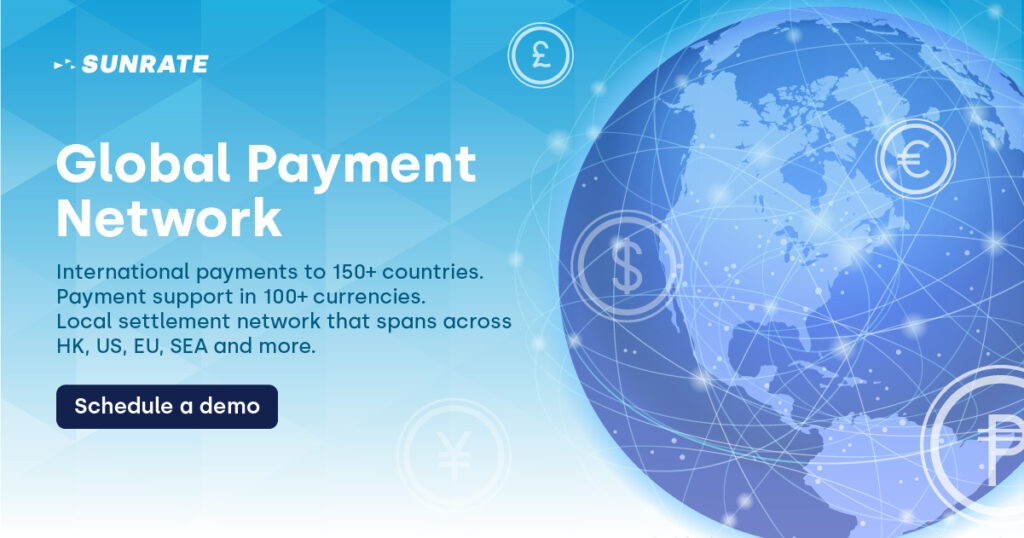
With our global headquarters in Singapore and offices in Hong Kong, Jakarta, London and Shanghai, SUNRATE partners with the top global financial institutions, such as Citibank, Standard Chartered, Barclays and is the principal member of Mastercard, Visa, and UPI. We are licensed and regulated by the Financial Conduct Authority of the UK, the Bank Indonesia, the Hong Kong Customs, and the Monetary Authority of Singapore.
To find out more about how SUNRATE can help your business via B2B payments, connect with us today.
Share to



When e-commerce scaled in the early 2000s, the infrastructure providers that captured disproportionate value were not the ones with the most merchants or the most consumer relationships. They were the ones that built the payment rails, the fraud detection networks, and the settlement infrastructure that every merchant and every transaction depended on. The value flowed […]


The shift toward autonomous agentic commerce is reshaping how B2B platforms handle value movement, buyer-seller discovery, and transaction execution. While consumer commerce relies on quick UI friction reduction, B2B procurement operates on structured approvals, complex credit arrangements, multi-currency treasury constraints, and rigorous compliance standards. As enterprise AI agents evolve from read-only research tools into active commerce […]

Across enterprise procurement functions, a pattern is emerging that should concern every CFO, CPO, and Head of Compliance paying attention. AI procurement agents — deployed to automate supplier discovery, purchase order generation, invoice matching, and payment initiation — are operating in production environments where the governance frameworks that should define, constrain, and audit their behaviour have not yet been established. This […]
We hope to use cookies to better understand your use of this website. This will help improve your future experience of accessing this website. For detailed information on the use of cookies and how to revoke or manage your consent, please refer to our < privacy policy >. If you click the confirmation button on the right, you will be deemed to have agreed to use cookies.


