
The travel industry operates on margins that leave almost no room for error. An online travel agency processing millions of transactions annually cannot treat payment failure rates as an acceptable operational variable. A hotel group with properties across twelve countries cannot manage treasury as an afterthought and expect its finance function to keep pace with the commercial operation it is meant to serve.
And yet, across the travel industry, payment infrastructure is routinely treated as a back-office concern — a cost to be minimised rather than a capability to be built. The consequence of this framing is not just operational inefficiency. It is measurable margin erosion that compounds with every transaction processed through systems that were never designed to work together.
The Hidden Cost Calculation
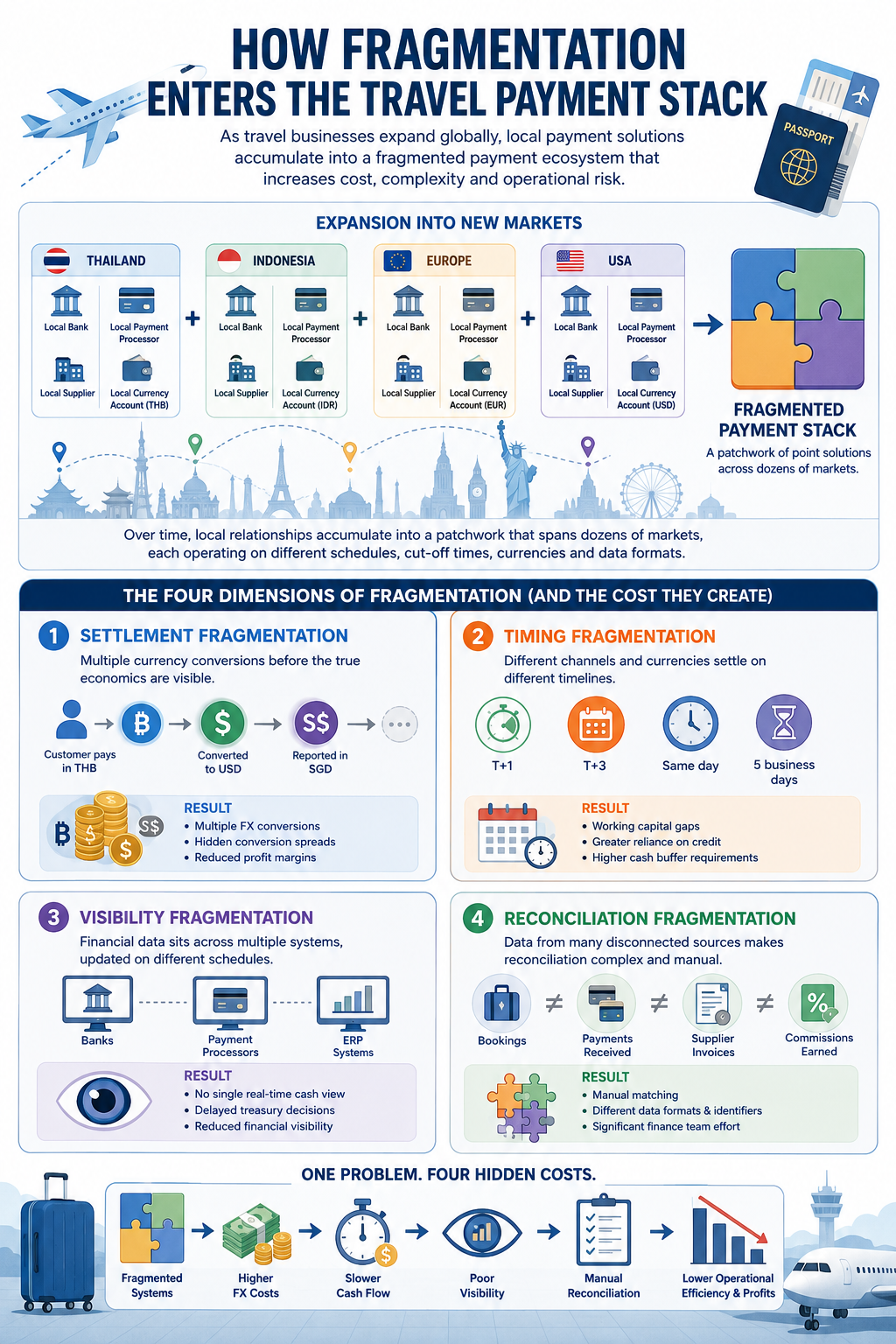
The cumulative cost of payment fragmentation in travel is rarely calculated in its entirety — because no single line item captures it. It is distributed across FX spreads, payment processing fees, working capital costs, reconciliation overhead, and the operational decisions made on the basis of incomplete financial visibility.
Consider a mid-sized online travel agency processing $200 million in annual bookings across eight Asian markets. The FX cost of converting collections and paying suppliers through a fragmented banking structure — with each conversion carrying a spread of 1–2% rather than the interbank-adjacent rates available through consolidated payment infrastructure — represents $2–4 million in annual margin. At an industry operating margin of 8–12%, this is not a rounding error. It is a material proportion of profitability.
Add the working capital cost of settlement timing mismatches — funds sitting in transit across multiple settlement cycles — and the reconciliation overhead of manual matching across disconnected systems, and the total cost of payment fragmentation begins to look less like an operational inefficiency and more like a structural drag on commercial performance.
The fragmentation tax is not visible in any single report. It is distributed across the P&L in ways that are easy to attribute to other causes — market conditions, pricing pressure, supplier cost increases. But the businesses that have consolidated their payment infrastructure and measured the before-and-after consistently find that a significant proportion of the margin they thought they were losing to competition was actually being lost to payment architecture.
What Consolidated Payment Infrastructure Actually Changes
The alternative to payment fragmentation is not a single global bank. It is consolidated payment infrastructure — a platform layer that sits across the organisation’s existing banking relationships and payment flows, providing unified visibility, consistent FX execution, and coordinated settlement without requiring the replacement of every local relationship that took years to build.
In practice, consolidated payment infrastructure changes four things simultaneously.
1. FX execution becomes systematic rather than opportunistic
Instead of converting currency whenever a settlement event requires it at whatever rate is available through whichever banking relationship processes the transaction, consolidated infrastructure enables systematic FX management: monitoring rates across currency pairs continuously, executing conversions within defined parameters, and reducing the timing variability that is the primary driver of FX cost leakage.
2. Working capital becomes visible and manageable
When settlement timing across all payment channels is visible in a single, continuously updated view, rather than distributed across multiple banking portals on different update schedules, the finance team can actively manage working capital rather than reactively filling gaps. Anticipated shortfalls are visible before they materialise. Surplus positions are identified and redeployed rather than sitting idle.
3. Reconciliation becomes continuous rather than periodic
Payment data flowing into a unified platform is reconciled as it arrives rather than at end-of-day batch cycles. Discrepancies surface in minutes rather than the following morning. The manual reconciliation exercise, which in fragmented environments can absorb a full day of finance team time each week, is reduced to exception review rather than systematic data assembly.
4. Supplier relationships improve
Travel businesses that can pay suppliers reliably, in their preferred settlement currency, with predictable timing, are suppliers that travel businesses want to work with. The commercial relationships that drive preferential rates, allocation priority, and commercial flexibility are built on payment reliability and payment reliability is a function of infrastructure quality, not just organisational intent.
The Strategic Reframe
The travel industry’s relationship with payment infrastructure needs a strategic reframe — from cost centre to margin lever.
Every percentage point of FX cost reduction achieved through systematic execution rather than opportunistic conversion flows directly to the bottom line. Every working capital day recovered through consolidated settlement visibility reduces financing cost. Every hour of finance team time redirected from manual reconciliation to commercial analysis is an hour of expertise applied where it generates value rather than where it absorbs it.
The margin pressure facing travel businesses in 2026, from increased competition, platform consolidation, and consumer pricing sensitivity, is real. At the same time, so is the margin that is being silently eroded by payment infrastructure that was designed for a simpler, smaller, single-market operation and has never been rebuilt for the global business it now serves.
The businesses that treat payment infrastructure as a strategic investment (rather than a back-office cost) are the ones that will find margin where their competitors are finding pressure. The fragmentation that has accumulated over years of international expansion is not inevitable. It is a choice that can be unmade, one consolidated payment layer at a time.
To get started and partner with a solutions provider that can help your business optimise payments and help you scale both locally and globally, open a SUNRATE account today or contact our sales team.
Share to


When e-commerce scaled in the early 2000s, the infrastructure providers that captured disproportionate value were not the ones with the most merchants or the most consumer relationships. They were the ones that built the payment rails, the fraud detection networks, and the settlement infrastructure that every merchant and every transaction depended on. The value flowed […]


The shift toward autonomous agentic commerce is reshaping how B2B platforms handle value movement, buyer-seller discovery, and transaction execution. While consumer commerce relies on quick UI friction reduction, B2B procurement operates on structured approvals, complex credit arrangements, multi-currency treasury constraints, and rigorous compliance standards. As enterprise AI agents evolve from read-only research tools into active commerce […]
Across enterprise procurement functions, a pattern is emerging that should concern every CFO, CPO, and Head of Compliance paying attention. AI procurement agents — deployed to automate supplier discovery, purchase order generation, invoice matching, and payment initiation — are operating in production environments where the governance frameworks that should define, constrain, and audit their behaviour have not yet been established. This […]
We hope to use cookies to better understand your use of this website. This will help improve your future experience of accessing this website. For detailed information on the use of cookies and how to revoke or manage your consent, please refer to our < privacy policy >. If you click the confirmation button on the right, you will be deemed to have agreed to use cookies.


