
The Infrastructure That Was Built for Domestic Payments Is Becoming the Foundation for Cross-Border Ones
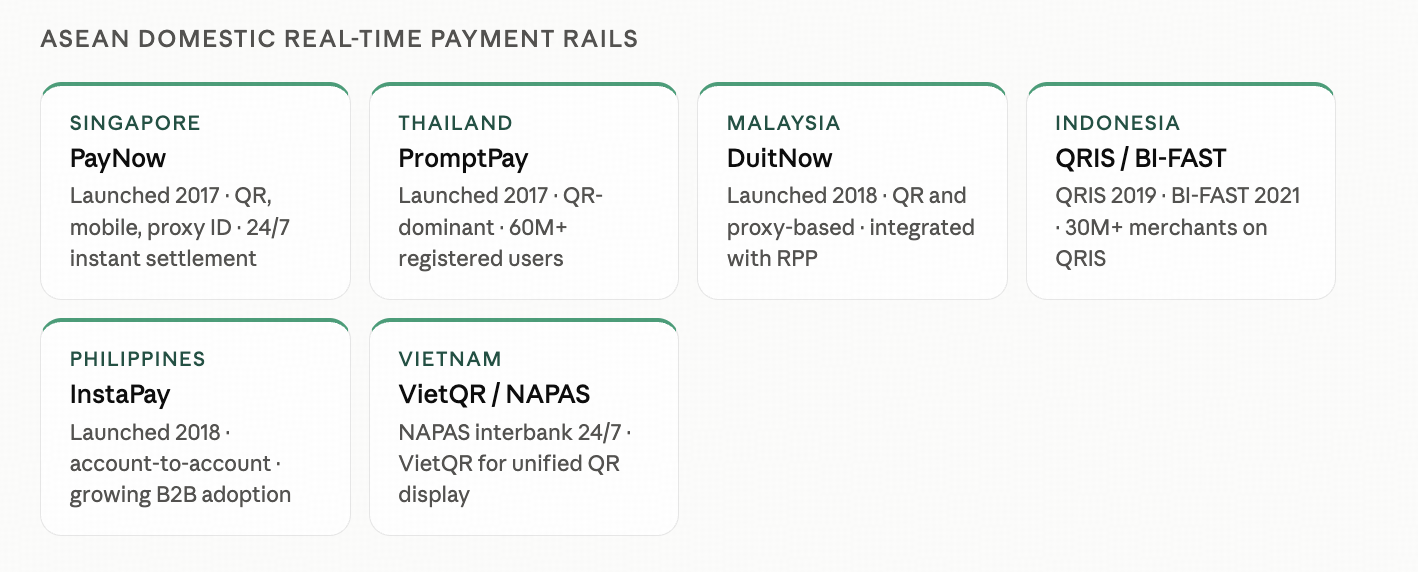
Real-time payment rails were not designed with cross-border commerce in mind. PromptPay in Thailand, PayNow in Singapore, QRIS in Indonesia, DuitNow in Malaysia, InstaPay in the Philippines — each was built to solve a domestic problem: the friction, cost, and latency of moving money between accounts within a single country. The cross-border problem was someone else's mandate.
Something has shifted. The domestic rails that achieved critical adoption mass, which processing millions of transactions daily, embedded in the payment behaviour of consumers and businesses alike, are now being connected to each other. Bilateral linkages between national real-time payment systems are turning what was a collection of domestic infrastructure investments into the early architecture of a regional payment network. And that network is beginning to reshape how businesses think about cross-border payment strategy in ASEAN and beyond.
The implications are not incremental. When the rails that process domestic payments in seconds become the rails that process cross-border payments in seconds — at domestic-equivalent cost, with local payment method support on both ends — the strategic calculus for businesses operating across ASEAN changes fundamentally.
What Bilateral Rail Linkages Actually Change
The connection of domestic real-time rails through bilateral linkages is not simply a speed upgrade for cross-border payments. It changes the structural economics and the user experience of cross-border transactions in ways that cascade through payment strategy.
What changes immediately when bilateral rails connect:
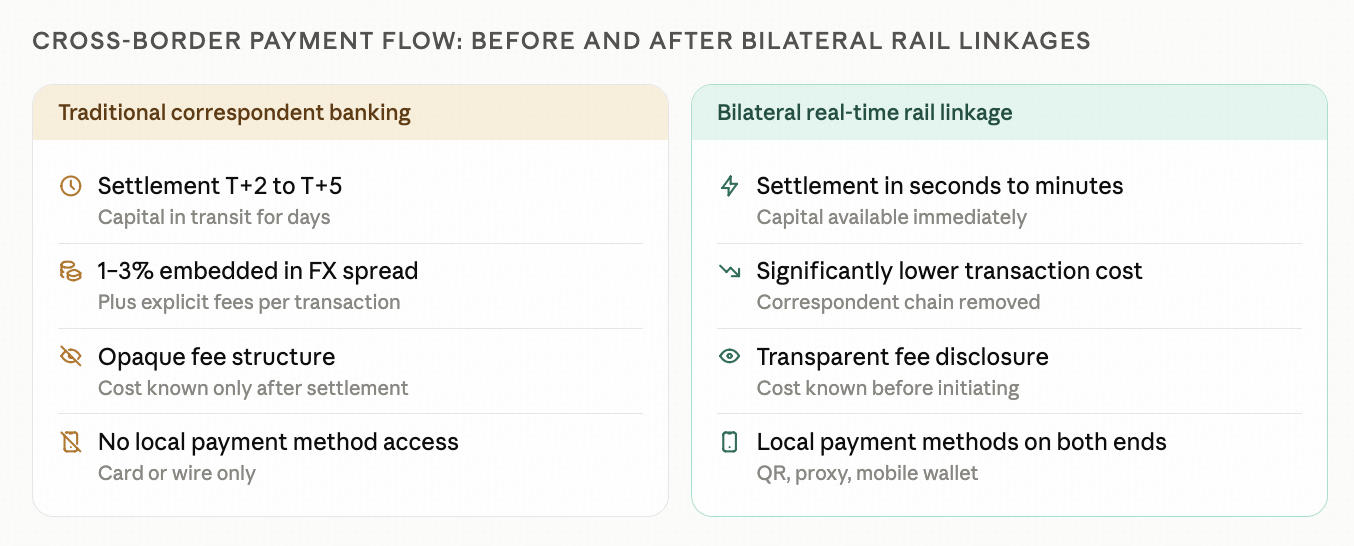
• Settlement time collapses from two to five business days to seconds or minutes — removing the timing uncertainty that has always complicated cross-border cash flow planning
• Cost structure shifts significantly — payments routed through connected domestic rails avoid the correspondent banking chain that has historically been the primary source of cross-border payment cost
• Local payment method access becomes available on both ends of a cross-border transaction — a Singapore business can pay a Thai supplier through PromptPay, and a Thai customer can pay a Singapore merchant through PayNow, using the payment methods they use for domestic transactions every day
• Transparency improves — real-time rail transactions carry explicit fee disclosure and predictable settlement timing, replacing the opacity of correspondent banking chains where fees are embedded in exchange rates and settlement timing is variable
What does not change immediately:
• FX conversion still occurs as bilateral rail linkages connect the rails but do not eliminate the need for currency exchange between SGD and THB, or MYR and IDR. How that conversion is managed, such as the rate, the timing and the spread, remains a consequential variable
• Regulatory compliance requirements in each market still apply bilateral linkages do not harmonise the AML, KYC, and reporting requirements of the connected jurisdictions
• Not all corridors are connected — the bilateral linkage network is growing but not yet comprehensive. Businesses operating across markets that lack direct linkages still navigate traditional cross-border payment infrastructure for those corridors
The Strategic Implications for Businesses Operating Across ASEAN
For businesses with payment flows across multiple ASEAN markets, the growing bilateral rail network changes three strategic considerations that were previously constrained by payment infrastructure.
• Market entry economics: The traditional cost of entering a new ASEAN market included a significant payment infrastructure component — establishing local banking relationships, integrating local payment methods, and managing the cost of cross-border settlement for payments to and from the new market. Bilateral rail linkages reduce this infrastructure burden: a business with an existing connection to a real-time rail network in its home market can, through bilateral linkages, reach customers and pay suppliers in connected markets through familiar infrastructure rather than building new relationships from scratch.
• Working capital management: Settlement delays in cross-border payment flows are not just operationally inconvenient — they have a working capital cost. Capital that is in transit in a correspondent banking chain is capital that cannot be deployed. For businesses processing significant cross-border payment volumes, the working capital cost of T+2 or T+3 settlement across multiple corridors is material. Real-time settlement through bilateral rail linkages reduces this cost directly: capital moves in seconds, not days, and the working capital efficiency gain compounds across every transaction.
• Supplier and customer experience: In ASEAN markets where QR-based real-time payment is the dominant consumer and small business payment behaviour, offering a payment experience that aligns with local habits is a commercial differentiator, not just a convenience. A cross-border e-commerce merchant that can accept payment from Thai customers through PromptPay QR — the payment method those customers use for every domestic transaction — reduces checkout friction in ways that card-based alternatives cannot match.
Beyond ASEAN — The Wider Real-Time Rail Connectivity Picture
The ASEAN bilateral linkage network is the most developed example of domestic rail interconnection, but it is not the only one. The strategic implications for cross-border payment strategy extend beyond the region.
India's UPI has established bilateral linkages with Singapore (PayNow–UPI), the UAE, and is in active development with several other markets. With 10 billion monthly transactions domestically, UPI's international extension represents a significant shift in cross-border payment accessibility for businesses serving Indian markets or receiving payments from Indian consumers and businesses.
The Arab Monetary Fund's Buna platform is connecting real-time payment infrastructure across Arab League member states — creating a regional rail network with comparable ambitions to ASEAN's bilateral linkage programme.
The European Payments Initiative (EPI) is building Wero, a unified European wallet and real-time payment instrument, with cross-border interoperability across EU member states as a design objective.
What this means for global businesses:
• The era of uniformly slow and expensive cross-border payments is ending — but the timeline differs by corridor, and businesses that map their specific corridors against the emerging rail network will find both near-term opportunities and persistent gaps
• Payment strategy that assumes cross-border payments will always require traditional correspondent banking infrastructure is strategy built on a foundation that is being dismantled corridor by corridor
• The competitive advantage in the near term belongs to businesses that identify which of their payment corridors already have live rail linkages and redirect volume to capture the cost and speed benefits — while continuing to manage remaining corridors through appropriate infrastructure
The Direction Is Clear. The Speed of Arrival Varies.
Domestic real-time rails are becoming cross-border infrastructure. The bilateral linkage network connecting them is growing — not uniformly, not instantly, but directionally and with the backing of central banks, payment authorities, and multilateral institutions across ASEAN and beyond.
The businesses that treat this shift as a background development to monitor are the businesses that will discover the opportunity retrospectively, when the cost and speed advantages of connected rails have already been captured by competitors who moved earlier.
The infrastructure that was built for domestic payments is becoming the foundation for cross-border strategy. The strategic question is not whether to engage with it — it is how quickly.
To get started and partner with a solutions provider that can help your business optimise payments and help you scale both locally and globally, open a SUNRATE account today or contact our sales team.
Share to


When e-commerce scaled in the early 2000s, the infrastructure providers that captured disproportionate value were not the ones with the most merchants or the most consumer relationships. They were the ones that built the payment rails, the fraud detection networks, and the settlement infrastructure that every merchant and every transaction depended on. The value flowed […]


The shift toward autonomous agentic commerce is reshaping how B2B platforms handle value movement, buyer-seller discovery, and transaction execution. While consumer commerce relies on quick UI friction reduction, B2B procurement operates on structured approvals, complex credit arrangements, multi-currency treasury constraints, and rigorous compliance standards. As enterprise AI agents evolve from read-only research tools into active commerce […]

Across enterprise procurement functions, a pattern is emerging that should concern every CFO, CPO, and Head of Compliance paying attention. AI procurement agents — deployed to automate supplier discovery, purchase order generation, invoice matching, and payment initiation — are operating in production environments where the governance frameworks that should define, constrain, and audit their behaviour have not yet been established. This […]
We hope to use cookies to better understand your use of this website. This will help improve your future experience of accessing this website. For detailed information on the use of cookies and how to revoke or manage your consent, please refer to our < privacy policy >. If you click the confirmation button on the right, you will be deemed to have agreed to use cookies.


