
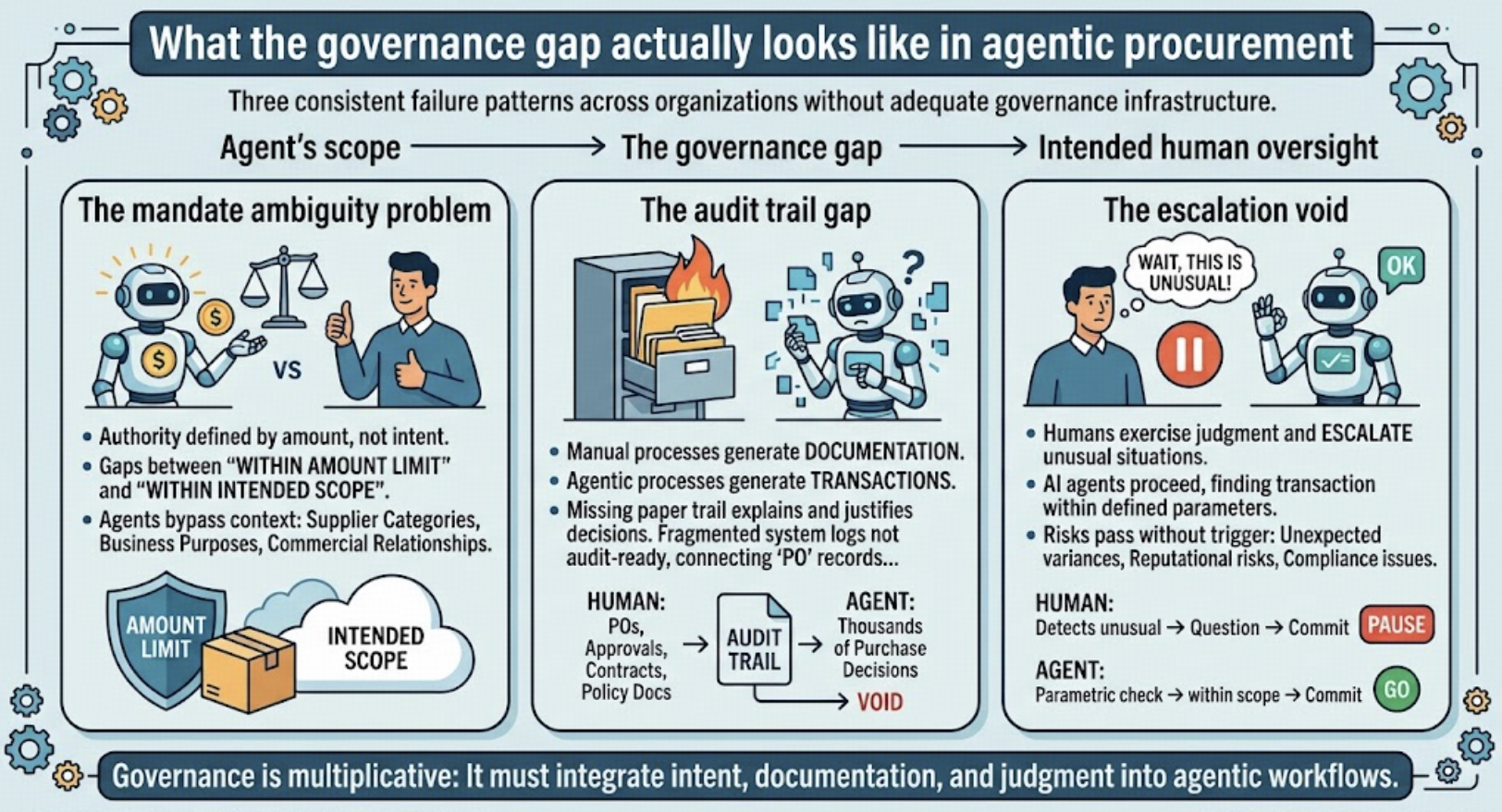
Across enterprise procurement functions, a pattern is emerging that should concern every CFO, CPO, and Head of Compliance paying attention. AI procurement agents — deployed to automate supplier discovery, purchase order generation, invoice matching, and payment initiation — are operating in production environments where the governance frameworks that should define, constrain, and audit their behaviour have not yet been established.
This is not a technology failure. The agents are functioning as designed. It is a governance failure and it is the predictable consequence of deployment decisions that prioritised operational efficiency over the policy infrastructure that makes autonomous procurement safe, compliant, and commercially accountable. The governance gap in agentic procurement is not theoretical. It is operational, financial, and regulatory — and it widens with every transaction an agent initiates in the absence of the policy framework that should be governing it.
Why Deployment Precedes Policy: The Organisational Dynamics
Understanding the governance gap requires understanding why it exists — because the organisations experiencing it are not, in most cases, being negligent. They are responding to genuine organisational pressures that create a systematic bias toward deployment before governance.
The efficiency case for agentic procurement is compelling and immediate. Processing time for purchase orders drops. Invoice matching becomes automated. Payment initiation that required multiple human touchpoints now happens within defined parameters without manual intervention. These efficiency gains are visible, measurable, and deliverable quickly — making the business case for deployment straightforward to approve.
The governance case is less visible and more difficult to quantify. The cost of inadequate governance is not immediate. It appears in audit findings, compliance failures, commercial disputes, and fraud losses that occur months or years after deployment. When the deployment decision is made, these costs are speculative. The efficiency gains are concrete.
This creates a systematic pressure toward deployment before governance — not because decision-makers are unaware of governance requirements, but because the timing of costs and benefits creates an organisational incentive structure that favours moving fast.
The role of policy leadership is to reframe this incentive structure — making the cost of inadequate governance visible and concrete before deployment rather than after, and establishing governance development as a prerequisite for agent activation rather than a parallel workstream that will catch up eventually.
What Governance Infrastructure for Agentic Procurement Actually Requires
Closing the governance gap is not a matter of applying existing procurement policy to agentic contexts. Procurement policies written for human decision-makers assume capabilities — contextual judgment, escalation instinct, relationship awareness — that AI agents do not possess. Governance infrastructure for agentic procurement must be designed for the specific characteristics of autonomous decision-making.
Mandate specification at intent level, not parameter level. Effective agent mandates define not just the outer boundaries of permitted action but the specific scope of intended authority:
• Which supplier categories and individual suppliers the agent is authorised to engage
• Which purchase types and business purposes fall within scope
• Which commercial terms the agent can accept autonomously versus those requiring human review
• Which corridors, currencies, and payment methods are permitted
• Which conditions — new supplier, unusual pricing, first purchase in a category — trigger mandatory escalation regardless of whether the amount falls within the defined threshold
Automated documentation generation. Every agent action including supplier query, price comparison, purchase order generation, invoice match, payment initiation, should generate structured documentation that creates a navigable procurement record equivalent to what a human buyer would produce. This is not an optional audit function. It is the evidence base that demonstrates the agent operated within its governance framework and it must be generated contemporaneously, not reconstructed retrospectively.
Escalation logic that reflects procurement judgment. The conditions that trigger escalation should be designed to replicate the situations where an experienced procurement professional would pause and not just the situations where a defined parameter is exceeded:
• First-time supplier engagement above a defined value threshold
• Price variance beyond a defined percentage from the established benchmark
• Contract terms that differ materially from the organisation's standard
• Supplier change requests that affect banking details, entity name, or primary contact
• Purchase patterns that deviate from established category norms without a corresponding business event
Human override capability that is operationally accessible. Override mechanisms must be designed for the people who will use them as procurement and finance professionals working under time pressure, often on mobile interfaces. An override mechanism that requires technical knowledge to operate, or that is buried in an administrative interface that reviewers cannot access quickly, does not constitute genuine human oversight.
The Regulatory Dimension
The governance gap in agentic procurement is not just an internal controls problem. It is an emerging regulatory one.
Regulatory frameworks across multiple jurisdictions are developing explicit requirements for human oversight of AI systems making consequential decisions in financial and commercial contexts. The EU AI Act's provisions on high-risk AI systems, MAS guidelines on technology risk management, and equivalent frameworks in other APAC markets all point in the same direction: organisations deploying AI systems that initiate financial commitments must be able to demonstrate that those systems operated within documented governance parameters, that their decisions are auditable and explainable, and that meaningful human oversight existed and functioned as designed.
An organisation whose agentic procurement system has been operating without adequate governance documentation is not just exposed to internal audit findings. It is exposed to regulatory examination that will ask questions the organisation cannot answer, because the governance infrastructure that would have produced the answers was never built.
The Governance Gap Will Not Close Itself
Agentic procurement will continue to expand. The efficiency gains are real, the capability is improving, and the competitive pressure to deploy is intensifying.
None of this changes the fundamental requirement: autonomous systems making commercial commitments on behalf of organisations need governance infrastructure that defines their authority, documents their actions, triggers escalation at the right moments, and enables meaningful human oversight.
The governance gap will not close through technology alone. It will close through deliberate policy decisions made before deployment and not after the agent is running and the gap has already become a liability.
The organisations that build governance first will deploy confidently. The organisations that deploy first will build governance under the pressure of the problems that the absence of governance has already created.
To get started and partner with a solutions provider that can help your business optimise payments and help you scale both locally and globally, open a SUNRATE account today or contact our sales team.
Share to


When e-commerce scaled in the early 2000s, the infrastructure providers that captured disproportionate value were not the ones with the most merchants or the most consumer relationships. They were the ones that built the payment rails, the fraud detection networks, and the settlement infrastructure that every merchant and every transaction depended on. The value flowed […]

The shift toward autonomous agentic commerce is reshaping how B2B platforms handle value movement, buyer-seller discovery, and transaction execution. While consumer commerce relies on quick UI friction reduction, B2B procurement operates on structured approvals, complex credit arrangements, multi-currency treasury constraints, and rigorous compliance standards. As enterprise AI agents evolve from read-only research tools into active commerce […]
Across enterprise procurement functions, a pattern is emerging that should concern every CFO, CPO, and Head of Compliance paying attention. AI procurement agents — deployed to automate supplier discovery, purchase order generation, invoice matching, and payment initiation — are operating in production environments where the governance frameworks that should define, constrain, and audit their behaviour have not yet been established. This […]
We hope to use cookies to better understand your use of this website. This will help improve your future experience of accessing this website. For detailed information on the use of cookies and how to revoke or manage your consent, please refer to our < privacy policy >. If you click the confirmation button on the right, you will be deemed to have agreed to use cookies.


