
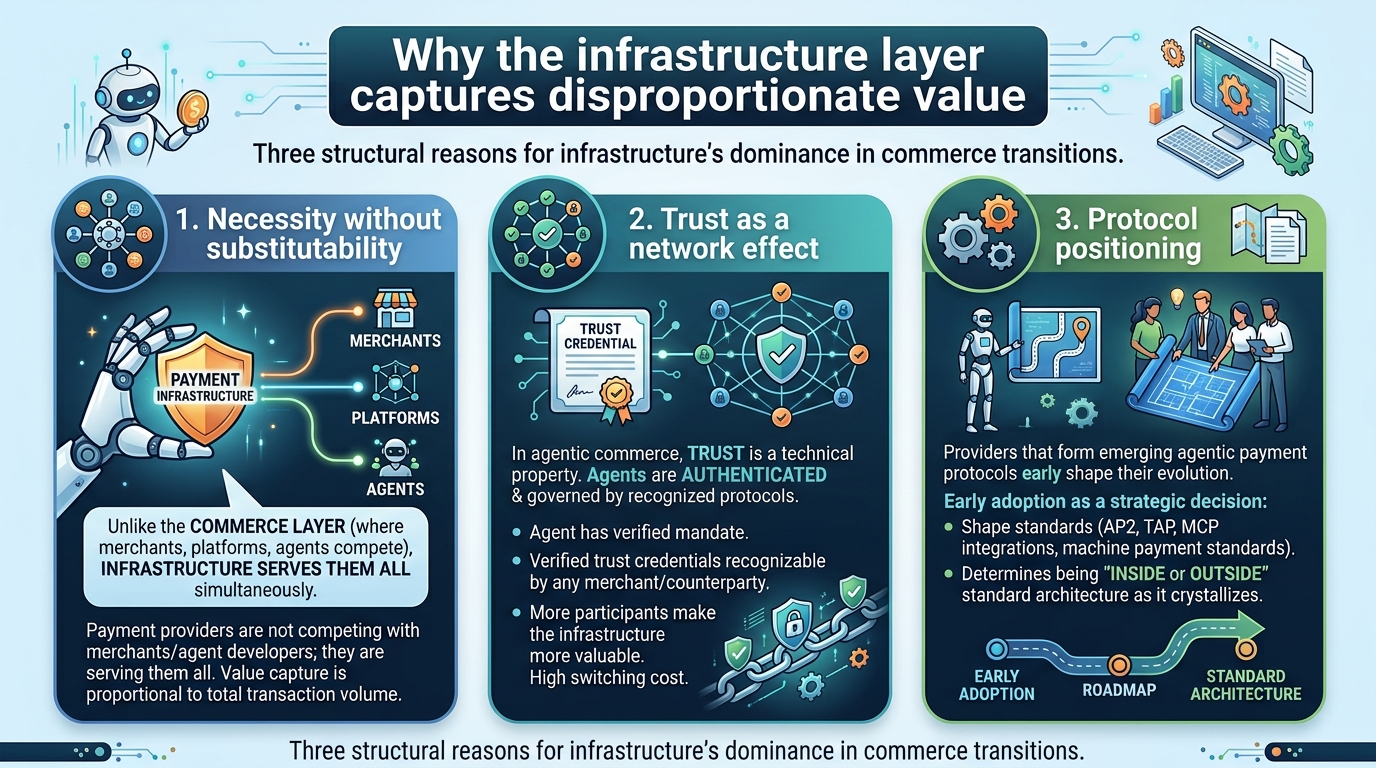
When e-commerce scaled in the early 2000s, the infrastructure providers that captured disproportionate value were not the ones with the most merchants or the most consumer relationships. They were the ones that built the payment rails, the fraud detection networks, and the settlement infrastructure that every merchant and every transaction depended on. The value flowed to the infrastructure layer.
The agentic commerce transition is structurally similar. AI agents are beginning to discover, negotiate, and purchase across B2B and B2C commerce at a scale that will, within a few years, represent a significant and growing share of global transaction volume. The merchants, the platforms, and the agent developers are already building.
The payment infrastructure layer that will underpin every agent-initiated transaction — authenticating agents, verifying mandates, executing payments, generating audit trails — is still being defined.
The providers that define it will capture disproportionate value. The question is which providers those will be.
What Infrastructure Providers Need to Build
The value capture opportunity in agentic commerce is real. It is not automatic. Capturing it requires payment infrastructure providers to build specific capabilities that do not exist in their current architecture — and to build them before the market has fully defined what it needs.
Agent identity and mandate verification infrastructure
The foundational capability that agentic commerce requires from payment infrastructure is the ability to verify that a payment-initiating agent is who it claims to be, and that the payment it is initiating falls within the scope of what it has been authorised to do.
This is not a marginal extension of existing KYC and authentication infrastructure. It is a new category of verification that addresses the specific characteristics of AI agent identity:
• Agent identity verification— confirming that the agent presenting credentials is a registered, legitimate entity and not a synthetic or compromised identityattemptingto exploit the authentication gap between human-designed security systems and machine-initiated payment flows
• Mandate scope verification— confirming that the specific payment the agent isinitiatingfalls within the full scope of its mandate, including supplier restrictions, transaction type limitations, amount thresholds, geographic restrictions, and time validity, not just within the outer amount limit
• Real-time mandate enforcement— blocking or escalating payments that fall outside mandate scope at the point of initiation, before funds move, rather than flagging them in post-settlement review
Providers that build this capability become the trust anchor for agentic payment flows and the infrastructure layer that merchants and counterparties depend on to verify that the agents initiating payments against them are legitimate and authorised.
Machine-readable payment endpoints
The checkout and payment initiation infrastructure that currently serves human buyers such as redirect sequences, CAPTCHA verification and UI-driven confirmation flows, does not serve AI agents.
Agents require machine-readable payment endpoints: API-native interfaces that can receive agent-initiated payment instructions, process authentication credentials programmatically, and return structured confirmation data that the agent can incorporate into its workflow.
Payment infrastructure providers that build machine-readable endpoints position themselves to receive agentic payment flows that providers without this capability cannot accept. As agent-initiated transactions grow as a proportion of total commerce volume, the providers accessible to agents capture a growing share of that volume while those that remain human-UI-dependent become progressively less accessible to a significant and expanding category of payment initiator.
Multi-protocol compatibility
The agentic payment protocol landscape is fragmented — AP2, TAP, MCP, MPP, x402, and emerging stablecoin rails are each addressing different aspects of the agentic payment stack, and no single protocol yet covers the full requirements of cross-border B2B agentic commerce.
A payment infrastructure provider that supports only one protocol is accessible only to agents operating within that protocol's ecosystem.
Multi-protocol compatibility, which is the ability to receive and process agentic payment flows regardless of which protocol the initiating agent is using, is the infrastructure equivalent of accepting multiple card schemes rather than a single network. The providers that build multi-protocol compatibility become accessible to the widest range of agent types and agent platforms, capturing volume from across the protocol landscape rather than from within a single standard.
Audit trail and compliance documentation infrastructure
Every agentic payment flow that passes through a payment infrastructure provider's rails generates a compliance record — the evidence that the agent was authenticated, the mandate was verified, the payment was within scope, and the transaction was executed as authorised. For merchants, this documentation is the defence against disputes and chargebacks arising from agent-initiated purchases. For enterprise buyers, it is the audit trail that demonstrates procurement compliance. For regulators, it is the evidence of appropriate AI payment governance.
The Strategic Positioning Decisions That Determine Value Capture
Building the technical capabilities above is necessary but not sufficient for capturing disproportionate value in the agentic commerce shift. Three strategic positioning decisions will determine which infrastructure providers emerge as the clear infrastructure layer of agentic commerce and which remain participants in a competitive market rather than foundational infrastructure.
• Protocol engagement over protocol neutrality
Infrastructure providers that engage actively in the development of agentic payment protocols — contributing to standards bodies, participating in working groups, providing implementation feedback to protocol developers — shape the standards in ways that reflect their infrastructure capabilities. Providers that remain neutral observers adopt whatever standards emerge — at a disadvantage relative to those who helped design them. Protocol engagement is not just a technical contribution. It is a positioning investment.
• Ecosystem integration over point-to-point connection
The value of payment infrastructure in agentic commerce is not determined by the number of direct connections a provider has established. It is determined by how deeply embedded the provider is in the agent development ecosystem — whether agent developers building on OpenAI, Anthropic, Google, and open-source platforms have native access to the provider's payment capabilities through the frameworks they are already using. Infrastructure providers that integrate with agent development platforms capture volume at the source — from the agents being built now, before those agents have selected their payment infrastructure.
• Trust registry participation
The agent identity verification infrastructure described above will, as the agentic payment ecosystem matures, likely consolidate around a small number of trust registries — databases of verified agent identities and mandate credentials against which merchants and counterparties can validate payment-initiating agents in real time. Infrastructure providers that participate in building and operating these registries, or that establish direct relationships with the registries that emerge, position themselves as the verification layer for agentic commerce. Providers that depend on third-party registries for agent identity verification are one layer further from the foundational infrastructure and one layer further from the value that infrastructure captures.
The Window Is Open But Will Not Stay Open
Commerce transitions create infrastructure winners in a compressed window, which is the period between when the new commerce model becomes clearly directional and when the infrastructure layer has crystallised around a small number of established providers. In that window, infrastructure investments that would be prohibitively expensive to make against an entrenched incumbent are viable because no incumbent yet exists.
The agentic commerce transition is in that window now. The commerce model is clearly directional. The infrastructure layer is still being defined. The protocol standards are still being developed. The trust registries are still being built.
The payment infrastructure providers that invest in agent identity verification, machine-readable endpoints, multi-protocol compatibility, and audit trail infrastructure now are not just building technical capabilities. They are building the foundational position in an infrastructure layer that will process a growing share of global commerce volume for the next decade.
Every major commerce transition has created a new class of infrastructure winner. The providers that capture disproportionate value in the agentic commerce shift will be the ones that recognise this moment for what it is and act accordingly.
To get started and partner with a solutions provider that can help your business optimise payments and help you scale both locally and globally, open a SUNRATE account today or contact our sales team.
Share to


When e-commerce scaled in the early 2000s, the infrastructure providers that captured disproportionate value were not the ones with the most merchants or the most consumer relationships. They were the ones that built the payment rails, the fraud detection networks, and the settlement infrastructure that every merchant and every transaction depended on. The value flowed […]

The shift toward autonomous agentic commerce is reshaping how B2B platforms handle value movement, buyer-seller discovery, and transaction execution. While consumer commerce relies on quick UI friction reduction, B2B procurement operates on structured approvals, complex credit arrangements, multi-currency treasury constraints, and rigorous compliance standards. As enterprise AI agents evolve from read-only research tools into active commerce […]
Across enterprise procurement functions, a pattern is emerging that should concern every CFO, CPO, and Head of Compliance paying attention. AI procurement agents — deployed to automate supplier discovery, purchase order generation, invoice matching, and payment initiation — are operating in production environments where the governance frameworks that should define, constrain, and audit their behaviour have not yet been established. This […]
We hope to use cookies to better understand your use of this website. This will help improve your future experience of accessing this website. For detailed information on the use of cookies and how to revoke or manage your consent, please refer to our < privacy policy >. If you click the confirmation button on the right, you will be deemed to have agreed to use cookies.


