
The future of AI in payments is not monolithic. It is not a single AI system that handles everything. It is a layered architecture in which different AI capabilities address different problems, human expertise concentrates where it adds the most value, and the integration between AI and human judgment is itself a designed capability rather than an afterthought.
Three signs have emerged from production payment AI deployments that point clearly in this direction.
Sign 1: The Escalation Rate Is the Performance Metric That Matters Most
In the early framing of AI payment operations, success was measured by automation rate such as the percentage of payment decisions handled by AI without human intervention. The higher the automation rate, the better the AI was performing. Human involvement was framed as a residual cost to be minimised.
Production deployments have reframed this almost universally. The metric that experienced payment AI operators focus on is not automation rate but escalation quality — the precision with which the AI system identifies the decisions that genuinely require human judgment and distinguishes them from the decisions it can handle more accurately than any human reviewer.
The distinction matters because maximising automation rate is the wrong objective.
An AI system that achieves 99% automation by handling cases it should not handle autonomously is not performing well as it is creating compliance exposure, relationship risk, and payment errors that will surface elsewhere in the operation. An AI system that achieves 85% automation but escalates the right 15% to human reviewers with full context and a clear recommendation performs better by every measure that actually matters.
What good escalation looks like in practice:
• Risk-ranked escalation queues which are exceptions surfaced to human reviewers in order of genuine risk significance, not in the order they entered the processing pipeline
• Context-complete escalation packages whereby every escalated case arrives with the full investigative context already assembled, i.e. counterparty history, transaction pattern analysis, regulatory flags, and the specific signal that triggered the escalation
• Recommended next action such as AI systems that not only identify the exception but recommend the most likely appropriate resolution, allowing human reviewers to confirm or override rather than beginning their analysis from scratch
• Feedback loop integration with human decisions on escalated cases feed back into the AI's escalation logic, continuously refining the boundary between what the system handles autonomously and what it escalates
This is the operational signature of a hybrid system. The AI is not trying to do everything. It is doing everything it can do reliably and routing the rest to humans in the most useful possible state.
Sign 2: Domain Expertise Is Becoming the Scarcest Input to Payment AI
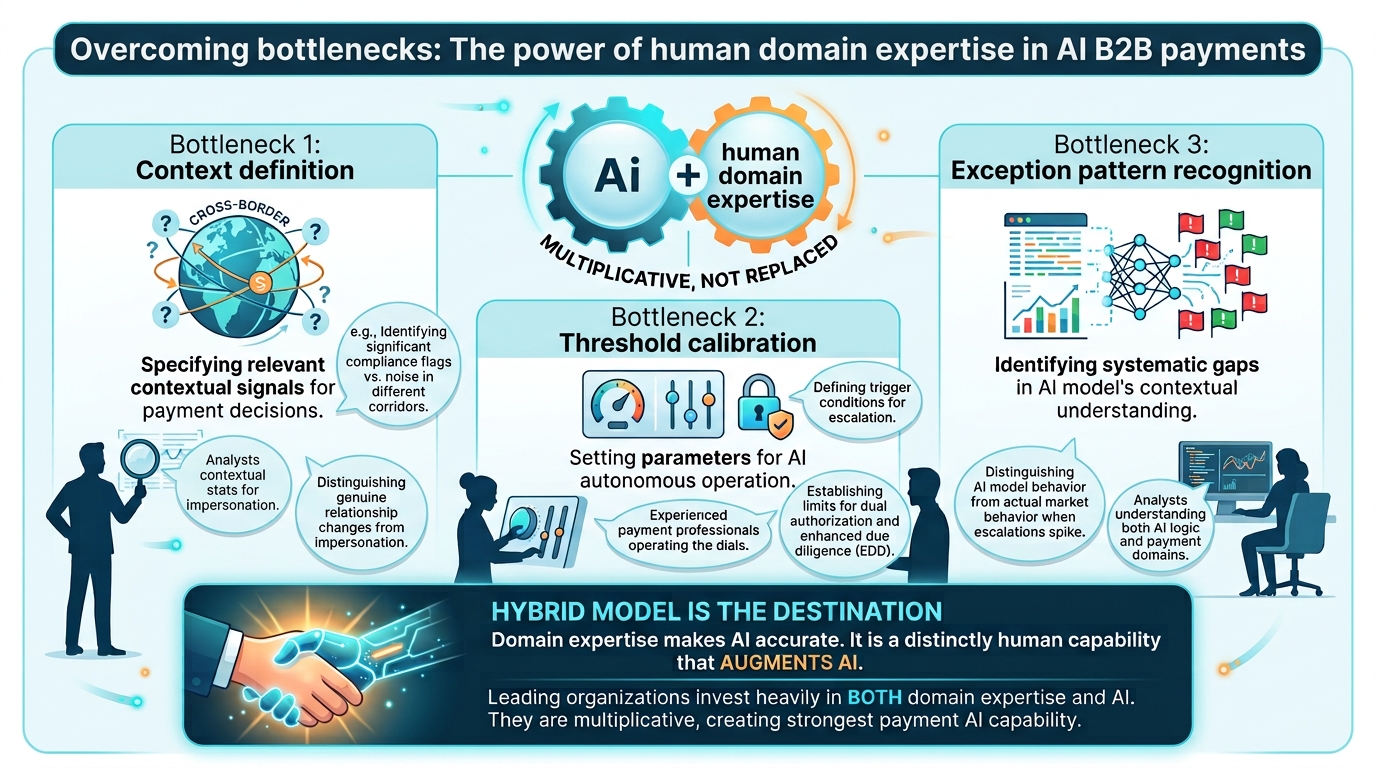
A second sign that payment AI is evolving toward hybrid rather than monolithic architecture is where the bottlenecks are appearing in production deployments. They are not in model performance. They are in domain expertise — the knowledge needed to tell the AI what context is relevant, which escalations matter, and how to interpret the signals it is generating.
This is a counterintuitive finding for organisations that framed AI adoption as primarily a technology investment. The technology is, in most cases, capable of more than the organisation can instruct it to do. The limiting factor is not the AI's ability to process information — it is the organisation's ability to translate its payment domain knowledge into the precise specifications that allow the AI to apply that knowledge correctly.
Sign 3: Regulatory Requirements Are Structurally Incompatible With Monolithic AI
The third and most definitive sign that payment AI is moving toward hybrid rather than monolithic architecture is regulatory. Across every major jurisdiction where AI payment systems are operating, the regulatory direction is consistent: AI can make payment decisions, but a human with appropriate authority must be able to review, understand, and override those decisions. Full AI autonomy in payment decision-making — without meaningful human oversight — does not satisfy this requirement.
The regulatory logic is straightforward. Payment decisions carry regulatory consequences. The institution making those decisions is accountable for them. An institution that cannot explain an AI-driven payment decision — that cannot identify which human is responsible for the outcome, present the reasoning behind the decision, or demonstrate that a meaningful override mechanism existed, is an institution that cannot satisfy the accountability requirements that payment regulation imposes.
This has three specific implications for how payment AI systems must be designed:
• Explainability is a design requirement, not an optional feature. AI payment systems that generate decisions without producing human-interpretable reasoning cannot satisfy regulatory examination. Explainability must be built into the system architecture from the start — retrofitting it onto a black-box model is significantly more difficult and less reliable
• Human override must be genuine, not nominal. Regulators are increasingly examining whether the human oversight mechanisms in AI payment systems represent real opportunities to review and redirect AI decisions, or whether they are procedural checkboxes that do not meaningfully affect outcomes. Override mechanisms that are technically present but practically inaccessible — buried in interfaces that reviewers cannot use under time pressure, or dependent on technical AI knowledge that payment operations staff do not have — do not satisfy the intent of oversight requirements
• Accountability must be assignable to a named human. The regulatory expectation is not that a payment decision was made by a system with appropriate governance documentation. It is that a specific person, with defined authority and accountability, is responsible for the outcome of that decision — whether they made it directly or oversaw an AI system that made it on their behalf
These requirements are not temporary — they reflect a deliberate regulatory philosophy about accountability in automated financial decision-making that is being reinforced, not relaxed, across MAS, HKMA, the EU AI Act, and equivalent frameworks.
A monolithic AI payment system — one that makes all payment decisions autonomously without structured human oversight — is not on a regulatory pathway to approval in any major payment market. The hybrid model is not just operationally superior. It is the only architecture that is regulatorily viable.
What Hybrid Actually Looks Like in Practice
The hybrid AI payment architecture that these three signs point toward is not a compromise between AI capability and human limitation. It is a deliberate design in which each component does what it does best:
• AI handles the high-volume, parameter-consistent decisions that benefit from speed, consistency, and the ability to process context at scale — routine payment execution, real-time compliance screening, initial risk scoring, pattern detection across large transaction populations
• Human expertise defines the contextual framework within which AI operates — the thresholds, the escalation logic, the exception patterns, the regulatory compliance parameters — and continuously refines that framework based on what the AI surfaces
• Human judgment decides the cases that fall outside the AI's reliable operating envelope — the genuinely complex, the contextually ambiguous, and the regulatorily sensitive decisions where accountability must be explicitly human
This is not the payment AI future that the early narrative described. It is more capable than that narrative, more resilient, and more aligned with the regulatory and operational realities of global payment operations.
The monolithic AI that handles everything autonomously was always a theoretical endpoint. The hybrid system that combines AI capability with human judgment and domain expertise is what is actually being built — by the organisations that are furthest ahead.

To get started and partner with a solutions provider that can help your business optimise payments and help you scale both locally and globally, open a SUNRATE account today or contact our sales team.
Share to


When e-commerce scaled in the early 2000s, the infrastructure providers that captured disproportionate value were not the ones with the most merchants or the most consumer relationships. They were the ones that built the payment rails, the fraud detection networks, and the settlement infrastructure that every merchant and every transaction depended on. The value flowed […]


The shift toward autonomous agentic commerce is reshaping how B2B platforms handle value movement, buyer-seller discovery, and transaction execution. While consumer commerce relies on quick UI friction reduction, B2B procurement operates on structured approvals, complex credit arrangements, multi-currency treasury constraints, and rigorous compliance standards. As enterprise AI agents evolve from read-only research tools into active commerce […]

Across enterprise procurement functions, a pattern is emerging that should concern every CFO, CPO, and Head of Compliance paying attention. AI procurement agents — deployed to automate supplier discovery, purchase order generation, invoice matching, and payment initiation — are operating in production environments where the governance frameworks that should define, constrain, and audit their behaviour have not yet been established. This […]
We hope to use cookies to better understand your use of this website. This will help improve your future experience of accessing this website. For detailed information on the use of cookies and how to revoke or manage your consent, please refer to our < privacy policy >. If you click the confirmation button on the right, you will be deemed to have agreed to use cookies.


