
Siloed payment operations rarely announce themselves. They reveal themselves gradually—in the time it takes to resolve a delayed payment, in the data that gets reported but never acted on, and in the moments when customers find themselves navigating your organisation instead of simply receiving answers.
As global payment operations become increasingly complex, these inefficiencies become harder to ignore.
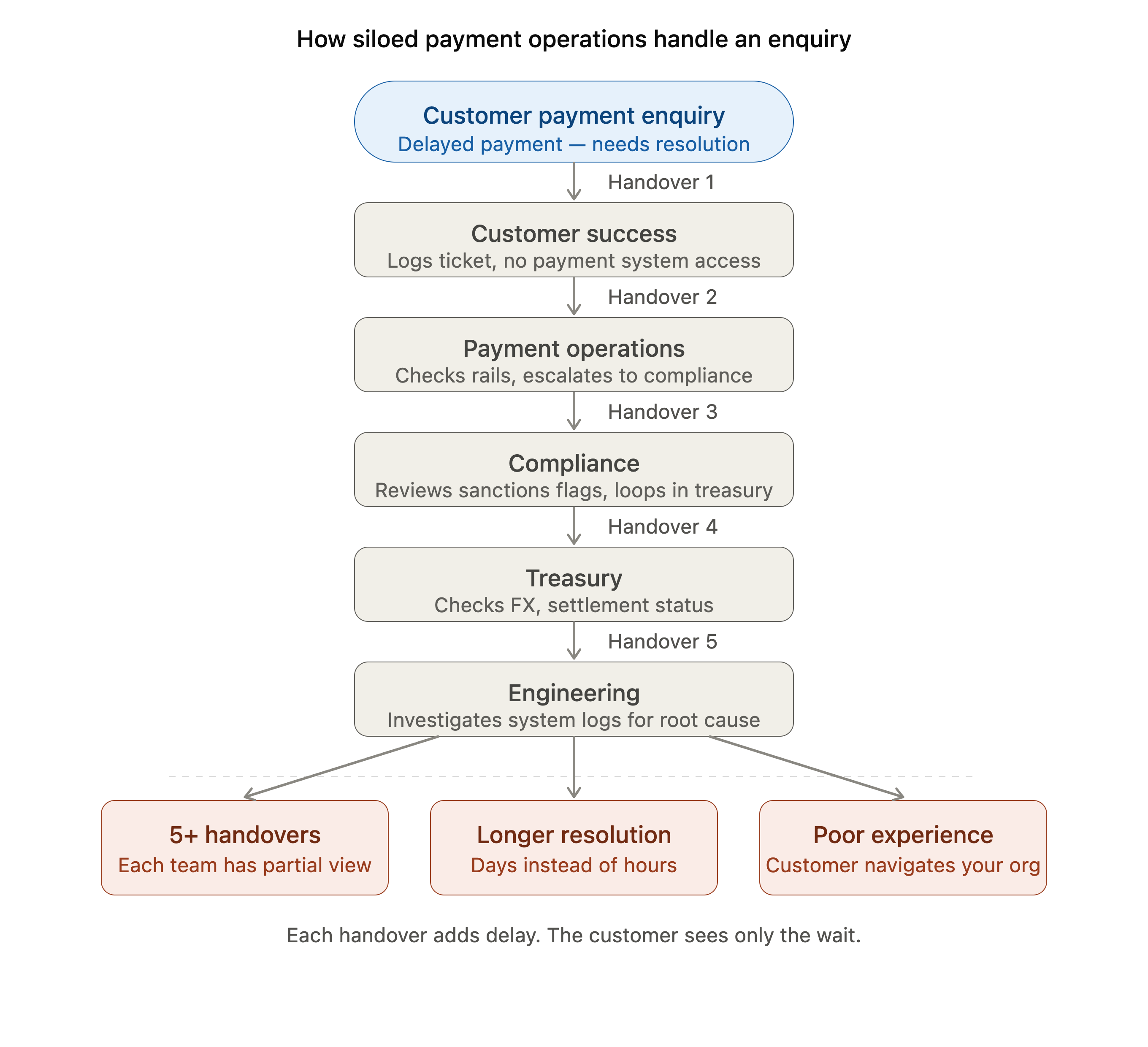
Sign #1: Resolving Payment Issues Requires Too Many Handovers
A delayed payment is rarely caused by a single issue. It could involve sanctions screening, FX conversion, a banking partner, reconciliation, or a local clearing network.
Warning signs include:
• Customers are transferred between multiple teams.
• Every department has only part of the answer.
• Internal escalations become the default workflow.
• Resolution times increase despite growing support resources.
Rather than relying on sequential handovers, leading payment providers build shared workflows that connect payment operations, compliance, treasury and engineering from the outset.
If resolving a straightforward payment enquiry regularly requires more than one or two internal handovers, it is worth examining whether the organisational structure is the constraint, not the complexity of the issue itself.
Sign #2: Payment Data Is Used for Reporting, Not Improvement
Most organisations already have the data.
The real question is whether that data drives operational decisions or simply fills dashboards.
Payment data should help identify:
• unreliable payment corridors
• recurring settlement delays
• FX execution issues
• onboarding friction
• compliance documentation gaps
Instead of treating every enquiry as an isolated case, connected payment teams identify patterns and address the underlying operational issue.
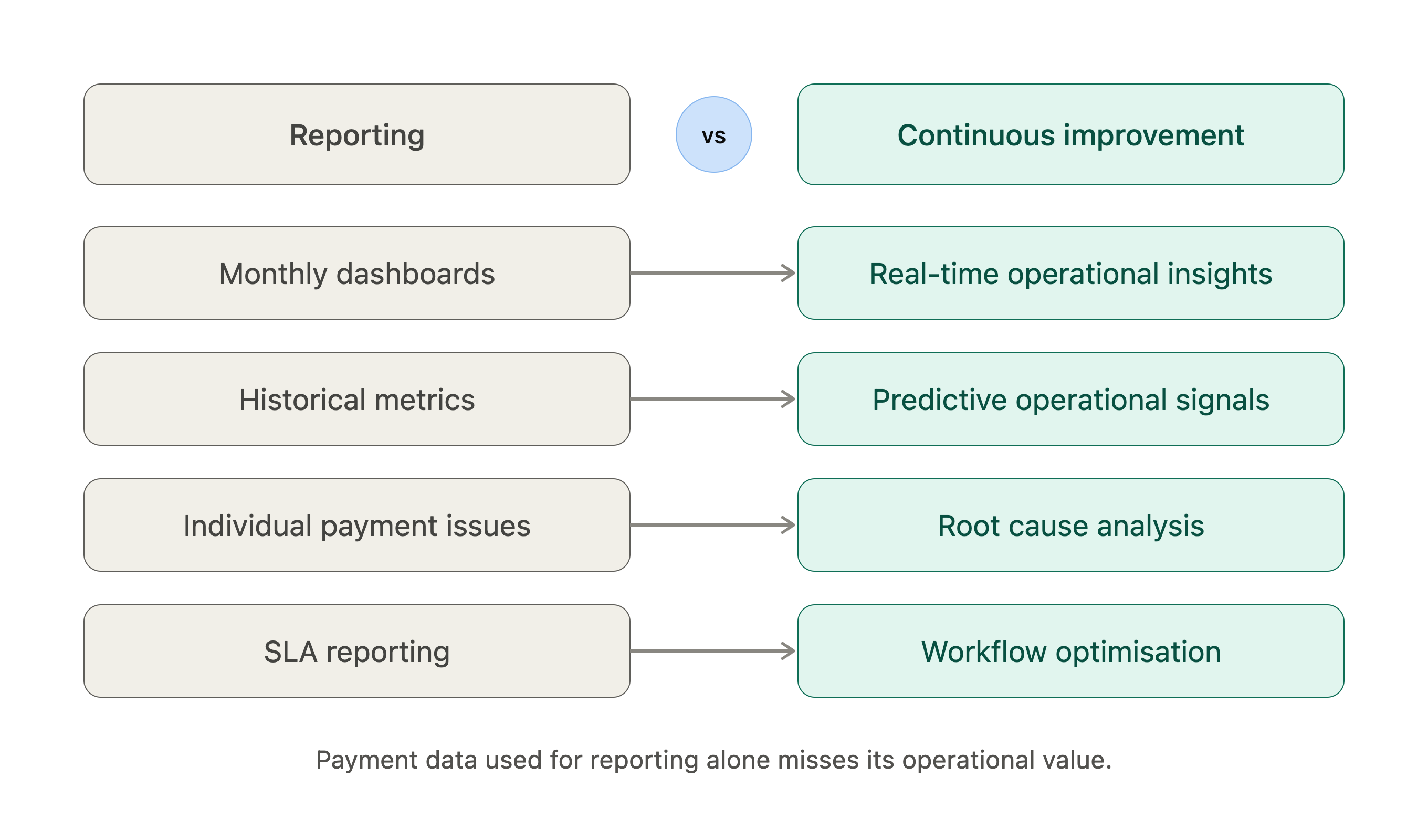
Siloed organisations tend to treat each payment issue as an isolated case — resolved individually, closed, and moved on from. Connected payment operations treat the same issues as data points in a broader operational pattern, routing the signal to the team that can address the root cause rather than just the immediate symptom.
The shift from reporting to improvement is not primarily a technology question. It requires a clear internal pathway understood by the teams that see the data, from operational signal to operational action. Without that pathway, even the most comprehensive payment data sits in a dashboard rather than driving the decisions it could inform.
Sign #3: Customers Have to Navigate Your Organisation
Enterprise customers increasingly expect payment providers to resolve issues across the entire payment lifecycle, not simply respond to enquiries. The distinction is important:
• Responding means acknowledging an issue and providing updates.
• Resolving means taking ownership until the customer receives a definitive answer or outcome.
When payment operations are siloed, the gap between these expectations becomes highly visible. Customers often experience:
• "We're waiting for another team."
• "We've escalated your request internally."
• Requests to explain the same issue to multiple contacts.
• Resolution timelines that continue to slip without meaningful updates.
In each of these situations, customers are not simply experiencing a delayed payment—they are experiencing the organisational boundaries behind it.
For enterprise businesses managing treasury operations, supplier payments or platform payouts across multiple markets, this creates significant operational friction. Their own operations depend on payment reliability and transparency, and when they are forced to navigate a provider's internal silos, the relationship shifts from one of operational partnership to operational management.
How Connected Payment Teams Respond Differently
Rather than relying on multiple internal handovers, connected payment teams focus on:
• Providing customers with rapid access to the right expertise.
• Providing customers with rapid access to the right expertise. Connecting payment operations, treasury, compliance and engineering through shared workflows.
• Using intelligent routing to direct issues to the appropriate specialists.
• Keeping organisational boundaries invisible to customers while maintaining clear internal ownership.
Ultimately, customers should experience one connected payment operation, regardless of how many teams are working behind the scenes. The more seamlessly expertise is coordinated internally, the more confidence enterprise customers have in the provider managing their global payments.
How to break down payment silos
Recognising the signs of siloed payment operations is the easier part. Addressing them requires structural investment, not just cultural intent.
The organisations making the most meaningful progress are focusing on three areas. The first is shared operational visibility, giving teams across payment operations, compliance, treasury, and engineering a common view of payment status, reconciliation data, and exception queues, so that diagnosing an issue does not require assembling information from separate systems.
The second is intelligent workflow routing building the internal pathways that connect a payment issue to the right specialist quickly, based on the nature of the issue rather than the organisational chart. The third is shared success metrics including measuring payment outcomes, customer experience, and operational resilience across teams, rather than evaluating each function against its own isolated targets.
None of these changes happen quickly. But the businesses that make them earliest will build the kind of payment operations that enterprise customers are increasingly selecting for, not just on the strength of their product, but on the coherence of the operation behind it.
To get started and partner with a solutions provider that can help your business optimise payments and help you scale both locally and globally, open a SUNRATE account today or contact our sales team.
Share to


When e-commerce scaled in the early 2000s, the infrastructure providers that captured disproportionate value were not the ones with the most merchants or the most consumer relationships. They were the ones that built the payment rails, the fraud detection networks, and the settlement infrastructure that every merchant and every transaction depended on. The value flowed […]


The shift toward autonomous agentic commerce is reshaping how B2B platforms handle value movement, buyer-seller discovery, and transaction execution. While consumer commerce relies on quick UI friction reduction, B2B procurement operates on structured approvals, complex credit arrangements, multi-currency treasury constraints, and rigorous compliance standards. As enterprise AI agents evolve from read-only research tools into active commerce […]
Across enterprise procurement functions, a pattern is emerging that should concern every CFO, CPO, and Head of Compliance paying attention. AI procurement agents — deployed to automate supplier discovery, purchase order generation, invoice matching, and payment initiation — are operating in production environments where the governance frameworks that should define, constrain, and audit their behaviour have not yet been established. This […]
We hope to use cookies to better understand your use of this website. This will help improve your future experience of accessing this website. For detailed information on the use of cookies and how to revoke or manage your consent, please refer to our < privacy policy >. If you click the confirmation button on the right, you will be deemed to have agreed to use cookies.


