
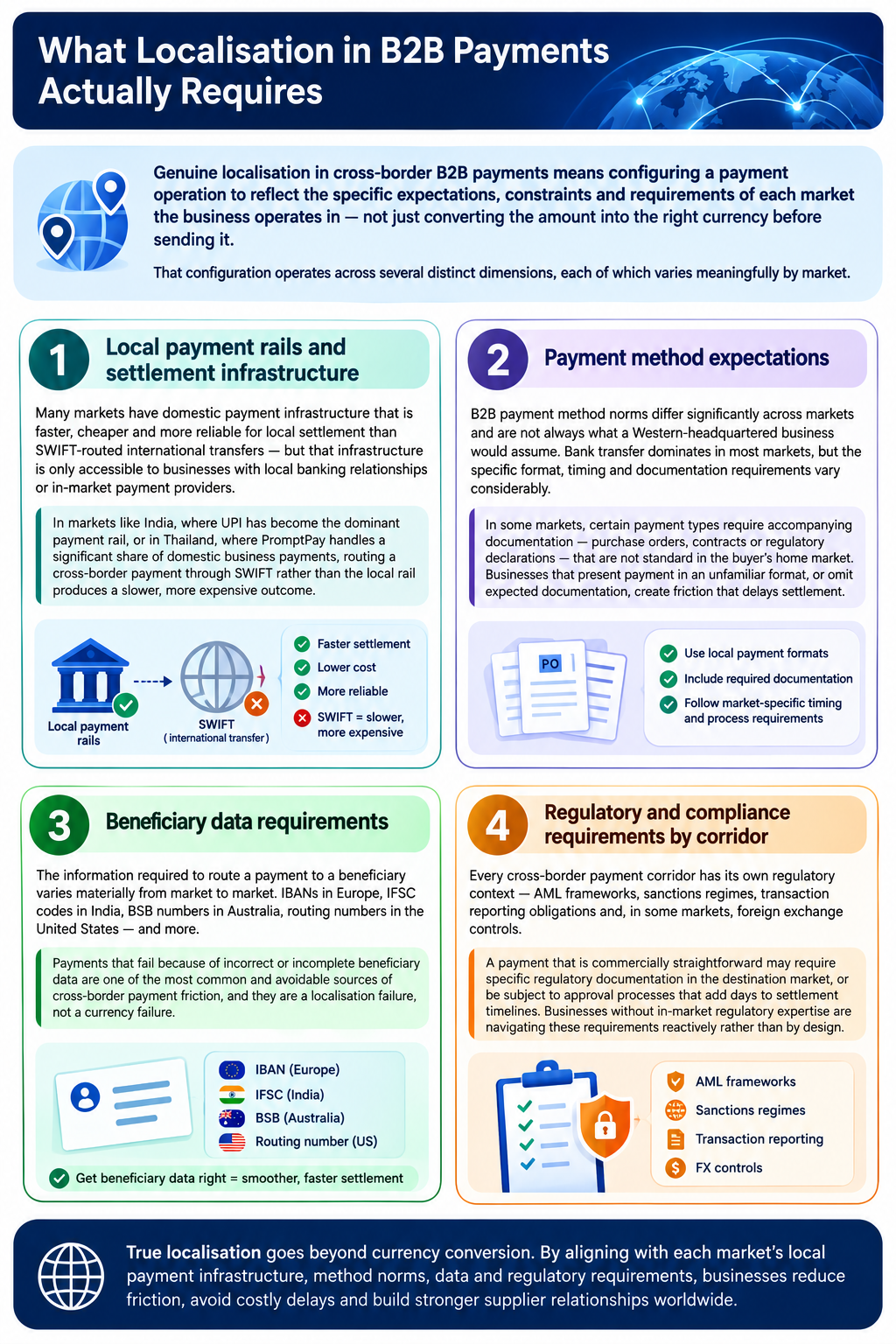
Currency conversion is the most visible part of a cross-border B2B payment. It is also, increasingly, the least difficult part. The harder localisation challenges sit beneath the exchange rate — in the regulatory frameworks, payment method expectations, banking infrastructure constraints, and compliance obligations that vary by market and that no amount of FX optimisation can resolve.
The currency conversion misconception
When businesses first expand into new international markets, the payment conversation tends to centre on currency. Which currencies do we need to support? What are the FX costs? How do we manage the exposure? These are legitimate questions, and getting the currency layer right matters. But treating currency conversion as the primary localisation challenge creates a blind spot that becomes increasingly costly as a business's cross-border footprint grows.
The businesses that have navigated international payment complexity most effectively are those that recognised early that currency is an input to localisation, not a proxy for it. Paying a supplier in their local currency is a necessary condition for a smooth cross-border payment relationship. It is rarely a sufficient one.
Where localisation failures show up
The consequences of inadequate payment localisation rarely appear as a single major failure. Instead, they accumulate as operational and commercial friction that affects the entire payment lifecycle.
Operational impacts
• Payment failures requiring manual intervention due to incorrect beneficiary information, unsupported payment formats or incompatible local payment requirements.
• Settlement delays that disrupt supplier cash flow and extend the time between payment initiation and funds availability.
• Compliance holds that delay payments while additional documentation is gathered retrospectively to satisfy local regulatory requirements.
• Poor supplier payment experiences when the payment process does not reflect the level of priority the buyer places on the commercial relationship.
Commercial impacts
Suppliers experiencing recurring payment delays, unexpected foreign exchange costs or settlement uncertainty are likely to factor those experiences into future commercial decisions, including:
• Pricing and contract negotiations
• Capacity allocation during periods of high demand
• Payment terms and credit flexibility
• Responsiveness when buyers require urgent fulfilment or operational support
Markets where localisation matteres most
• Southeast Asia: Payment infrastructure differs significantly across ASEAN markets, with domestic payment rails often providing faster and more cost-effective settlement than traditional SWIFT transfers. Businesses that localise only through currency conversion frequently encounter unnecessary payment friction.
• Sub-Saharan Africa: Mobile money infrastructure plays an increasingly important role in B2B settlement across certain corridors. Payment operations that are not designed to support local settlement methods can experience higher failure rates, slower settlement and increased operational complexity.
Why payment providers matter
Genuine payment localisation is not something a business can achieve purely through internal investment. It requires payment infrastructure partners that have done the local work — established banking relationships in destination markets, obtained the relevant regulatory licences, integrated with local payment rails, and built the operational knowledge of how payments actually move in specific corridors.
International reach is not the same as local infrastructure
The distinction between a payment provider that processes cross-border payments and one that is genuinely localised in a market is significant and not always visible from product documentation. A provider that routes payments through correspondent banking rather than local banking relationships offers international reach, but not true local infrastructure. The settlement experience for the end recipient — including payment speed, cost, and payment format — reflects that difference in ways that directly affect supplier relationships.
What to evaluate when selecting a provider
When assessing payment providers, businesses should look beyond the number of countries or currencies supported. More meaningful indicators of localisation capability include:
• The number of markets where the provider holds in-country licences
• The breadth of its local banking relationships
• The availability of local currency accounts
• The number of local payment rails it can access directly
These capabilities demonstrate genuine localisation. By contrast, broad geographic coverage often reflects the reach of a correspondent banking network rather than a provider's ability to deliver locally optimised payment experiences.
The business case for localisation
Investing in genuine payment localisation—configuring cross-border payment operations to reflect the specific requirements of each market rather than treating currency conversion as the primary adaptation—is often viewed as a cost. In practice, for businesses where cross-border supplier relationships are strategically important, it is better understood as an investment in supplier relationships with a measurable commercial return.
That return takes several forms: lower payment failure rates that reduce operational overhead and remediation costs; faster settlement that improves supplier cash flow and the commercial terms suppliers are willing to offer; fewer compliance holds that reduce uncertainty in payment timelines; and a payment experience that demonstrates to key suppliers that the business has invested in the infrastructure needed to be a reliable long-term partner.
Localisation goes beyond currency conversion
Currency conversion will always be an essential component of cross-border B2B payment localisation. However, businesses that outperform in international markets recognise that it is only the starting point. True localisation requires payment infrastructure that reflects the realities of each market—from local payment rails and regulatory requirements to beneficiary data standards and settlement practices—creating a payment experience that strengthens supplier relationships rather than introducing unnecessary friction.
To get started and partner with a solutions provider that can help your business optimise payments and help you scale both locally and globally, open a SUNRATE account today or contact our sales team.
Share to


When e-commerce scaled in the early 2000s, the infrastructure providers that captured disproportionate value were not the ones with the most merchants or the most consumer relationships. They were the ones that built the payment rails, the fraud detection networks, and the settlement infrastructure that every merchant and every transaction depended on. The value flowed […]

The shift toward autonomous agentic commerce is reshaping how B2B platforms handle value movement, buyer-seller discovery, and transaction execution. While consumer commerce relies on quick UI friction reduction, B2B procurement operates on structured approvals, complex credit arrangements, multi-currency treasury constraints, and rigorous compliance standards. As enterprise AI agents evolve from read-only research tools into active commerce […]

Across enterprise procurement functions, a pattern is emerging that should concern every CFO, CPO, and Head of Compliance paying attention. AI procurement agents — deployed to automate supplier discovery, purchase order generation, invoice matching, and payment initiation — are operating in production environments where the governance frameworks that should define, constrain, and audit their behaviour have not yet been established. This […]
We hope to use cookies to better understand your use of this website. This will help improve your future experience of accessing this website. For detailed information on the use of cookies and how to revoke or manage your consent, please refer to our < privacy policy >. If you click the confirmation button on the right, you will be deemed to have agreed to use cookies.


