
Finance teams today have access to more real-time payment information than at any previous point in history. Transaction statuses update in milliseconds. Settlement confirmations arrive within seconds. Dashboards refresh continuously. The volume and velocity of data flowing through payment operations have increased dramatically—yet decision confidence does not automatically increase with data speed. In fact, for many organisations, it has barely moved at all.
This is the paradox that defines the current moment in payments data: more information, faster, but not better decisions. The gap between data velocity and decision quality is not a data-speed problem alone. It is an architectural and operational problem involving how payment data is integrated, interpreted, governed, and converted into action.
Addressing this gap requires more than better dashboards or more frequent reporting. It requires a structural layer between data and decision—one that can consolidate fragmented information, supply missing context, and apply consistent logic to determine what data actually means and what action it should trigger.
This article examines three distinct failure modes that prevent faster payments data from producing better decisions.
The primary barrier to better decisions from faster payments data is not the absence of information but its structural fragmentation across systems, providers, and formats. Real-time data velocity makes this fragmentation harder, not easier, to manage.
Consider a finance team operating a modular cross-border payment stack: multiple providers, multiple currency rails, multiple settlement timelines. They receive payment data in multiple formats, on multiple schedules, through multiple interfaces. Each data stream is accurate within its own system. The problem is that no single system holds a complete, consistent, real-time picture of the business's payment position.
Faster data from each individual source accelerates the arrival of an incomplete picture. Not a complete one.
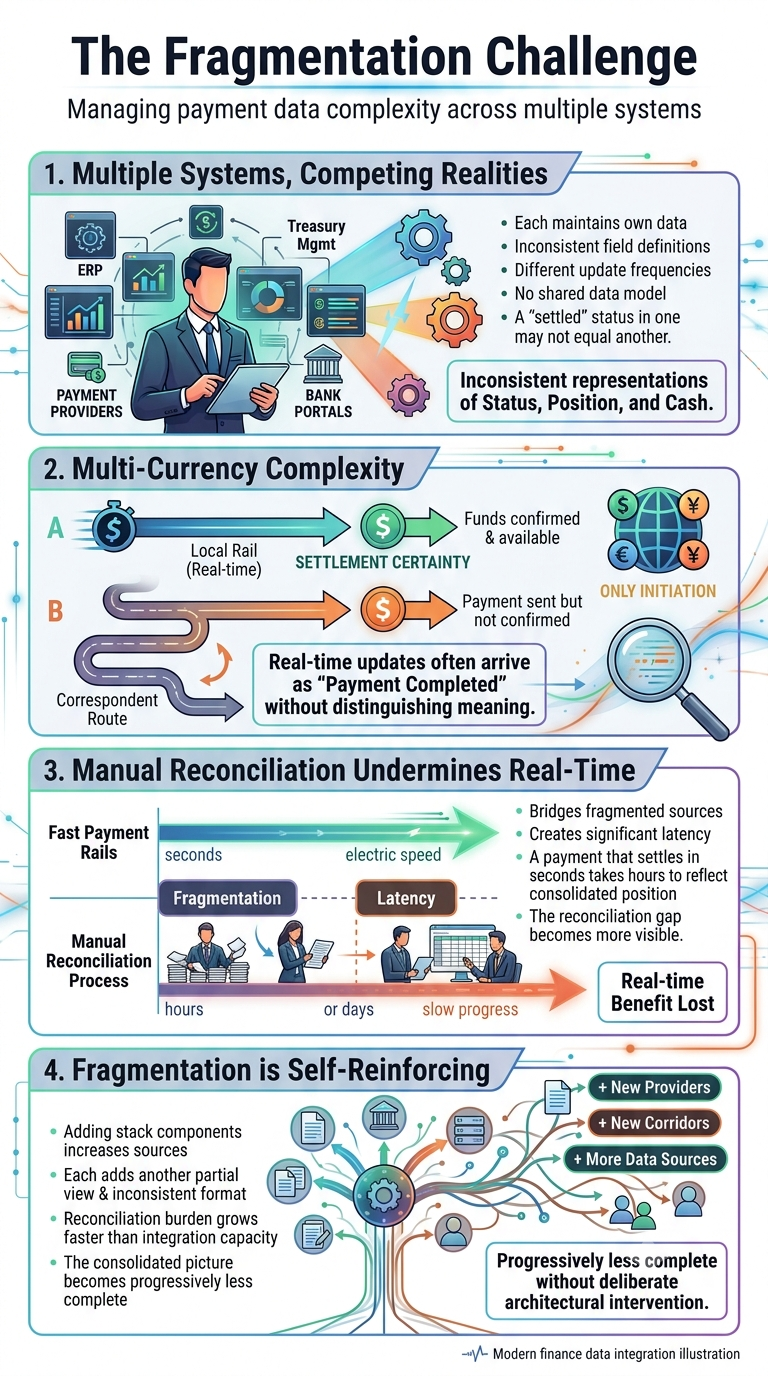
AI-driven data normalisation and consolidation can ingest payment data from multiple sources in multiple formats, apply consistent field mapping, and maintain a continuously updated, consolidated view of payment status, settlement position, and cash availability across providers and corridors.
Crucially, rather than inferring missing settlement information or correcting unreliable source data with unverifiable certainty, AI preserves data lineage, assigns confidence scores to consolidated records, and flags incomplete, inconsistent, or low-confidence data for exception handling and human review.
This approach replaces much of the manual reconciliation effort with an automated process while ensuring that decisions remain grounded in traceable, reliable information. Finance teams can trust the consolidated view because they can see where each data point originated, how it was transformed, and how confident the system is in its accuracy.
Raw payment data, even when complete and timely, does not contain the contextual information needed to interpret it correctly. In fast-moving data environments, the absence of context produces decisions that are confidently wrong rather than usefully uncertain.
Consider a spike in payment failure rates in a specific corridor. The raw data point is simple: failure rate has increased by X% in corridor Y. But what does it mean?
The failure spike could indicate a compliance issue such as new sanctions or regulatory restrictions affecting that corridor. It could be several issues like a banking partner outage as the financial institution processing those payments may be experiencing technical difficulties, or a beneficiary data quality problem whereby payments are being rejected because of incomplete or incorrect account information, and even a temporary capacity constraint on a local rail due to the payment system being overloaded and rejecting transactions.
The raw data point is the same in each case. The correct response is entirely different. Without the context to distinguish between these interpretations, faster data delivers faster misdiagnosis.
• Transaction systems are not decision systems
Payment data generated by real-time rails and API-first infrastructure is optimised for transaction processing, not decision support. It captures what happened—the amount, the timestamp, the status code. It does not capture why it happened or what it means for the business's financial position. The data is designed to settle payments, not to inform decisions.
• Context is distributed and disconnected
The contextual information needed to interpret payment data correctly is itself growing rapidly and is distributed across sources that are not natively connected to the payment data stream. Corridor-specific performance benchmarks, counterparty payment history, FX rate movements, regulatory change logs, banking partner status updates—all live in separate systems, separate formats, and separate mental models. Bringing them together in time to inform a decision is extraordinarily difficult.
• Cognitive load increases with velocity
Finance teams operating under time pressure in real-time data environments face an almost impossible cognitive burden: the faster data arrives, the less time is available to gather the context needed to interpret it correctly before a decision is required. Speed compresses the window for analysis, not the need for it.
• Cross-border operations multiply ambiguity
In cross-border payment operations, the same data signal can have different implications depending on the corridor, the currency, the counterparty type, and the regulatory environment. These variables are rarely captured in the payment data itself. A failure in one corridor may be routine; the same failure in another may signal a critical compliance issue. Without context, the distinction is invisible.
Contextual AI layers, drawing on historical corridor performance data, counterparty behavioural patterns, external market signals, and regulatory change feeds, can enrich raw payment data with the interpretive context needed to distinguish between signal and noise in real time.
These systems surface not just what the data shows but what it most likely means given current conditions and historical patterns. They can flag that a failure rate increase in a particular corridor is within historical norms for that corridor, or alternatively, that it exceeds all expected thresholds and correlates with a known banking partner incident.
This doesn't eliminate the need for human judgment, but it ensures that human judgment is applied to data that has already been interpreted in context, rather than to raw numbers that could mean almost anything.
The value of real-time payments data lies not in its speed but in the quality of the decisions it enables. When action triggers are poorly defined—or when finance teams lack clear, pre-agreed criteria for what data patterns require immediate response versus monitoring versus no action—real-time data creates urgency without direction.
The result is either over-reaction to noise or under-reaction to genuine signals. Both are made worse by the speed at which the data arrives.
• Inconsistent interpretation of the same signal
Where escalation thresholds and response criteria have not been formally defined, teams may interpret the same signal differently. One team member sees a minor fluctuation and dismisses it; another sees the same fluctuation and escalates urgently. The data is the same. The response is different. The outcome is unpredictable.
• Pressure to act visibly and immediately
Real-time data environments create social and organisational pressure to respond visibly and immediately. When data updates continuously, standing still feels like falling behind. This biases decision-making toward action over analysis and toward individual data points over pattern-level interpretation. Teams move fast and break things, and in payment operations, broken things cost money.
• Triaging at scale is exhausting and error-prone
In multi-currency, multi-corridor payment operations, the number of potential data signals requiring potential action at any given moment is large. Without prioritisation logic, finance teams are effectively triaging in real time, determining which signals matter and which don't, which require immediate action and which can wait, which represent genuine risk and which are operational noise. This is exhausting work, and it is error-prone at scale.
• Variable outcomes from identical information
Poorly defined action triggers create inconsistency across time and across team members. Different people respond differently to the same data signal depending on their individual risk tolerance, experience, and current workload. The same data that triggered a response on Monday may not trigger a response on Wednesday. The variability makes the operation difficult to manage and harder to improve.
AI-driven decision support systems can apply consistently defined action triggers across the full volume of real-time payment data. They surface only the signals that meet predefined escalation thresholds while filtering out operational noise. They can also present recommended actions alongside supporting evidence, confidence indicators, and priority rankings, enabling faster and more consistent decision-making.
Crucially, recommended actions should remain subject to clearly defined authority limits, approval workflows, and human review, particularly where they involve fund movements, compliance decisions, or material liquidity positions. AI supports decision-making; it does not replace governance over high-impact financial actions.
This approach ensures that speed accelerates the right decisions such as those that meet clear criteria and follow consistent logic, rather than creating chaos at velocity.
Looking Ahead
Faster payments data fails to produce better decisions when it arrives fragmented across systems, stripped of interpretive context, and without clearly defined triggers that translate data signals into appropriate action. Each of these failures is distinct, requiring a different AI capability to address:
• Fragmentation requires AI-driven normalisation and consolidation to create a complete, consistent view of payment position.
• Missing context requires AI-powered enrichment to supply the interpretive framework that turns raw data into meaningful information.
• Undefined triggers requires AI-facilitated decision support to apply consistent logic and prioritisation across the full volume of real-time data.
The gap between data velocity and decision quality is not closed by more data or faster data. It is closed by building the structural layer between data and decision that most payment operations are currently missing.
As payment rails accelerate further and data volumes continue to grow, the businesses that invest in the AI layer between data and decision now will compound that advantage. They will convert speed into clarity, noise into signal, and urgency into direction. Those that treat faster data as inherently more useful will find the gap between information and insight growing wider, not narrower.
The speed of your data is not the quality of your decisions. The difference between them is the architecture you build between the two.

To get started and partner with a solutions provider that can help your business optimise payments and help you scale both locally and globally, open a SUNRATE account today or contact our sales team.
Share to


When e-commerce scaled in the early 2000s, the infrastructure providers that captured disproportionate value were not the ones with the most merchants or the most consumer relationships. They were the ones that built the payment rails, the fraud detection networks, and the settlement infrastructure that every merchant and every transaction depended on. The value flowed […]


The shift toward autonomous agentic commerce is reshaping how B2B platforms handle value movement, buyer-seller discovery, and transaction execution. While consumer commerce relies on quick UI friction reduction, B2B procurement operates on structured approvals, complex credit arrangements, multi-currency treasury constraints, and rigorous compliance standards. As enterprise AI agents evolve from read-only research tools into active commerce […]
Across enterprise procurement functions, a pattern is emerging that should concern every CFO, CPO, and Head of Compliance paying attention. AI procurement agents — deployed to automate supplier discovery, purchase order generation, invoice matching, and payment initiation — are operating in production environments where the governance frameworks that should define, constrain, and audit their behaviour have not yet been established. This […]
We hope to use cookies to better understand your use of this website. This will help improve your future experience of accessing this website. For detailed information on the use of cookies and how to revoke or manage your consent, please refer to our < privacy policy >. If you click the confirmation button on the right, you will be deemed to have agreed to use cookies.


