
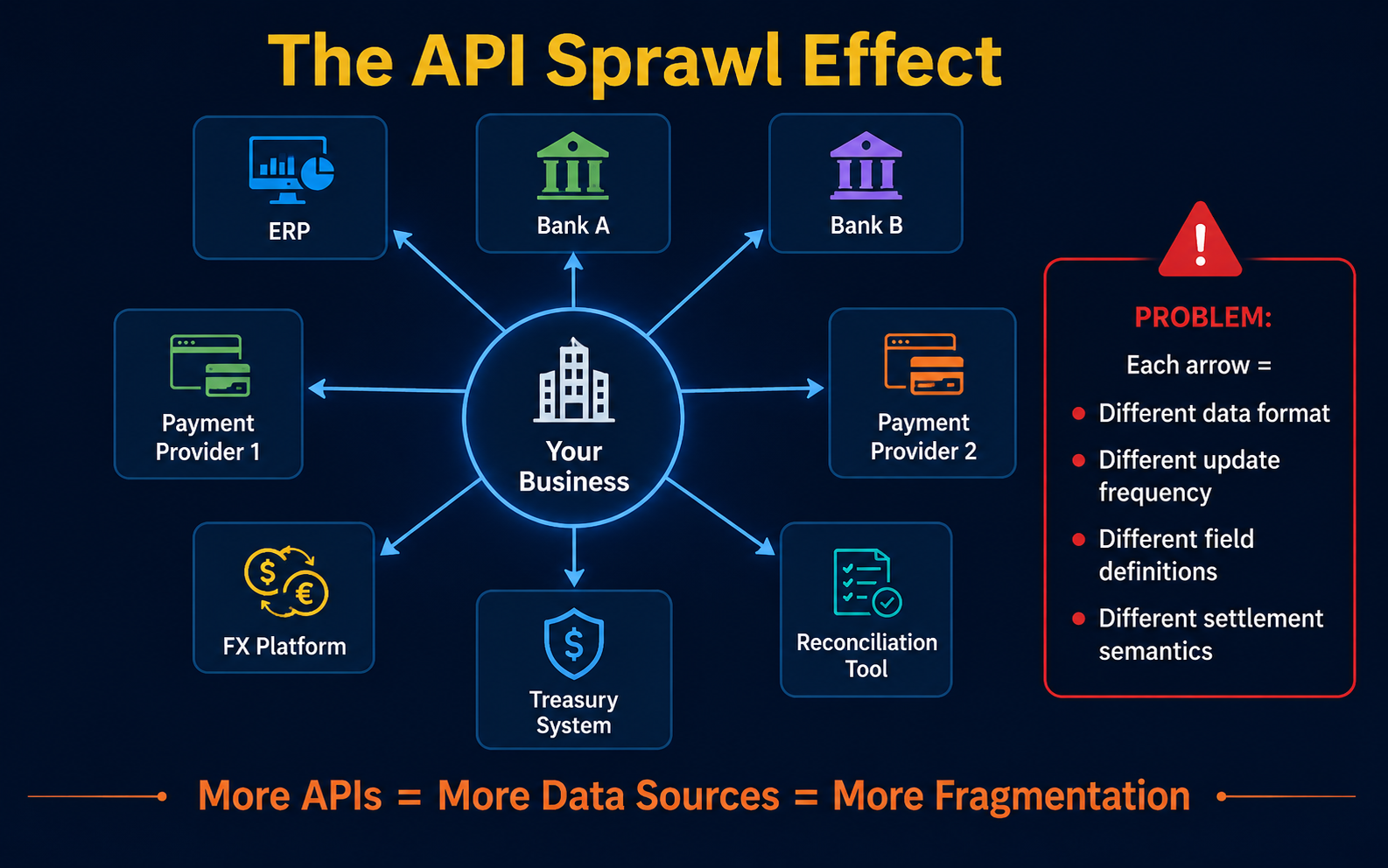
Your payment stack has never been more connected. APIs now link your ERP to multiple payment providers, bank portals, treasury systems, and reconciliation platforms. Data flows faster than ever. Webhooks deliver status updates in milliseconds. Dashboards refresh automatically.
And yet, your finance team spends more time reconciling data than ever before.
This is the integration paradox: more APIs are not producing better data. They are producing more data, arriving faster, in more formats, with less consistency. Integration velocity is actively undermining payment data quality — and most finance teams are measuring neither the problem nor its cost.
The promise of API-first payment architecture was unified, real-time visibility. The reality, for most global businesses, is a fragmented data environment where each new integration adds another partial view, another reconciliation burden, and another layer of uncertainty.
Why More APIs Don't Mean Better Data
In theory, adding payment providers through APIs should improve data quality. Each new source contributes unique information. Each new data stream fills a gap. Each new integration brings you closer to a complete picture.
In practice, the opposite happens.
The Three Ways Integration Velocity Kills Data Quality
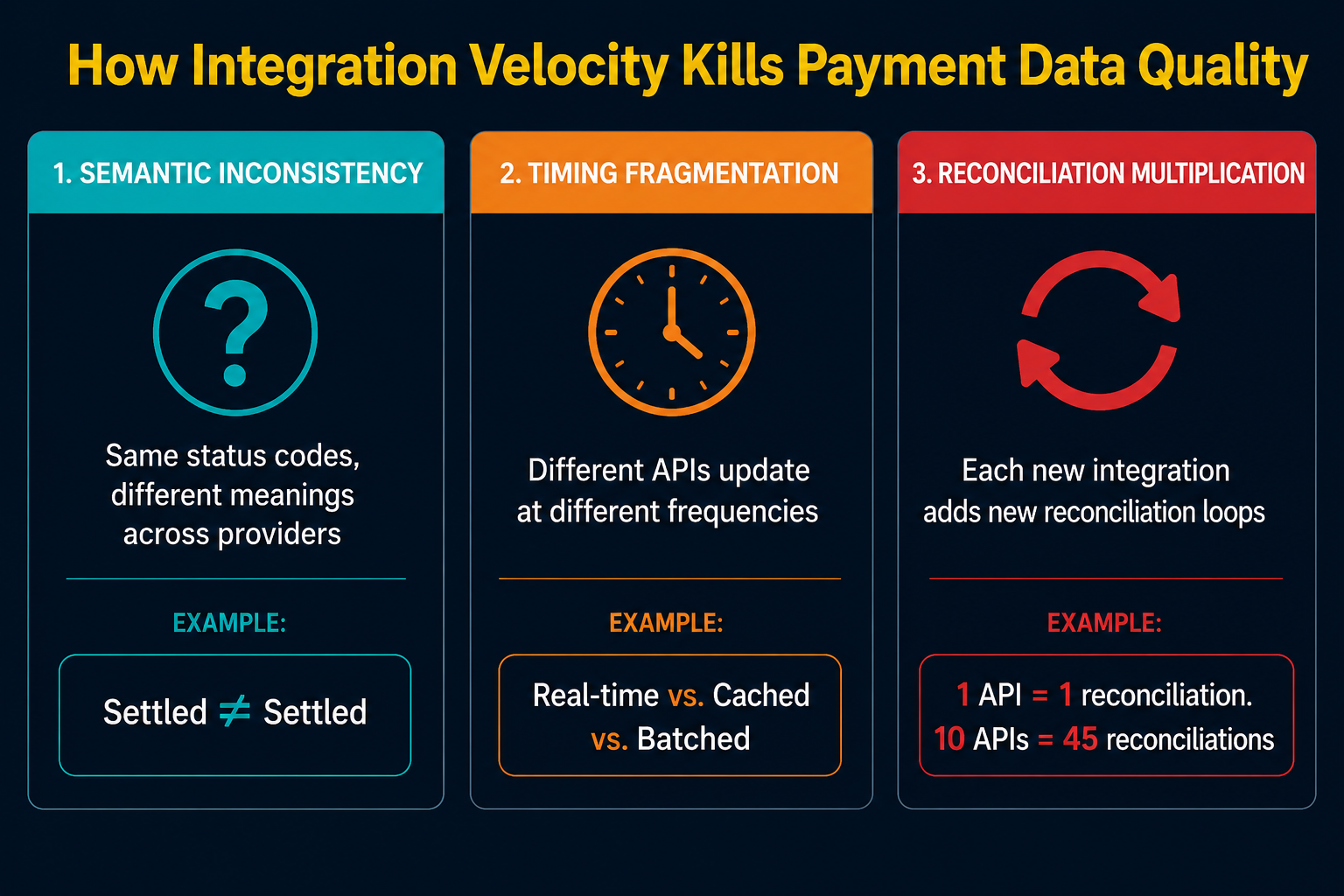
1. Semantic Inconsistency
Every payment provider uses its own data model. One provider's "settled" means funds are confirmed. Another's "settled" means the payment instruction has been sent to the beneficiary bank. A third's "settled" means the funds are available in your nostro account.
The status code is the same. The meaning is different. The data is consistent within each system — and inconsistent across all of them.
This semantic inconsistency is invisible when you view each system in isolation. It only becomes visible when you try to consolidate data across systems. And that consolidation is exactly what integration velocity makes necessary.
Let’s look at this realistic example:
|
Provider |
Status |
Actual Meaning |
|
Local Rail (Singapore PayNow) → |
"Completed" → |
Funds credited to beneficiary, final settlement |
|
Correspondent Banking Route → |
"Completed" → |
SWIFT message sent, funds in transit |
|
FX Platform → |
"Completed" → |
Currency converted, awaiting payment instruction |
|
Bank Portal → |
"Completed" → |
Batch file processed, settlement pending |
*Every provider says "completed." None of them mean the same thing.
2. Timing Fragmentation
Different APIs update at different frequencies. One provider delivers webhooks instantly. Another updates only at batch processing intervals. A third refreshes its API response on a 15-minute cache. When you consolidate data from these sources, you're not consolidating simultaneous views of reality. You're consolidating data from different points in time.
• Provider A's data: Real-time (2ms ago)
• Provider B's data: Cached (15 minutes ago)
• Provider C's data: Batched (2 hours ago)
The consolidated view is a chronological composite, not a real-time picture. Integration velocity creates the illusion of real-time visibility while delivering data from multiple time horizons.
The Global B2B Payment Complexity
Cross-border B2B payments make all of these problems worse.
Multiple corridors mean multiple settlement semantics. A "completed" payment in Singapore's PayNow means final settlement. A "completed" payment in a correspondent banking corridor from the US to Vietnam means the SWIFT message has been sent — with final settlement potentially days away.
Multiple currencies mean multiple data points for the same transaction. The transaction amount in USD. The settlement amount in EUR. The FX rate applied. The fees deducted. Each provider reports these fields differently, if they report them at all.
Multiple regulatory environments mean multiple reporting requirements. The same payment may need different data fields for compliance in different jurisdictions. Your API integrations must accommodate all of them — or your consolidated data will be missing critical regulatory information. Each of these factors multiplies the data quality challenge. In global B2B payments, integration velocity doesn't just break data quality. It breaks it across multiple dimensions simultaneously.
The Hidden Cost You're Not Measuring
What does this cost your business?
Cost A: Reconciliation labor
If your finance team spends 10 minutes reconciling each provider's data per day, and you have 10 providers, that's nearly 800 hours of reconciliation labor per year. Those hours are not spent on analysis, decision-making, or strategic work. They're spent making different APIs agree with each other.
Cost B: Delayed decisions
Poor data quality means delayed confidence. When you can't trust your consolidated view, you wait. You wait for manual confirmation. You wait for the month-end reconciliation. You wait to make decisions because your real-time data isn't reliable.
Cost C: Missed opportunities
Poor data quality means missed commercial opportunities. Failed payments go undetected. Settlement delays go unmanaged. FX exposure goes unhedged. The cost is visible only in the opportunities you didn't take because you couldn't see clearly enough to act.
Cost D: Compliance risk
Poor data quality means compliance gaps. If your consolidated payment data is incomplete or inconsistent, your regulatory reporting will be incomplete or inconsistent. This exposes your business to fines, penalties, and regulatory scrutiny.
Fixing the Problem: From More APIs to Better Data
Integration velocity isn't going to slow down. You will continue to add providers, corridors, and API integrations. The question is not whether to integrate more. The question is how to manage the data quality consequences.
The Solution Architecture
1. Data Normalisation Layer
Build or buy a data normalisation layer that ingests data from all providers, applies consistent field mapping, and maintains a single data model across sources. This layer sits between your providers and your business systems. It translates each provider's proprietary data model into a common standard.
2. Semantic Mapping
Define the meaning of each status, field, and data point. Map each provider's semantics to a common semantic standard. "Settled" means final settlement. "In Transit" means funds are on their way. "Initiated" means the instruction has been sent. Apply this map consistently to all incoming data.
3. Confidence Scoring
Not all data is equally reliable. Assign confidence scores to each data point based on the source provider's reliability, update frequency, and historical accuracy. Flag low-confidence data for exception handling. Make confidence visible to decision-makers.
4. Automated Reconciliation
Replace manual reconciliation with automated data comparison. The system compares data across providers, flags discrepancies, and routes exceptions for human review. This eliminates the reconciliation multiplication problem at scale.
5. Auditability and Lineage
Preserve the lineage of every data point. Know which provider supplied it, when it was updated, and what transformations were applied. This builds trust in the consolidated view and enables root-cause analysis of data quality issues.
The AI Layer
AI is uniquely suited to solve the data quality problem that integration velocity creates. AI can:
• Ingest data from multiple providers in multiple formats
• Apply consistent semantic mapping automatically
• Detect anomalies and data quality issues in real time
• Assign confidence scores based on pattern analysis
• Flag exceptions for human review
• Continuously learn from historical data quality patterns
The result is a consolidated, reliable, traceable view of payment data across all providers and corridors, without the reconciliation burden that integration velocity has traditionally imposed.
Data Quality as Competitive Advantage
The businesses that win in global B2B payments won't be those with the most APIs, the most integrations, or the most data sources. They'll be those with the most integrated, reliable, and traceable view of their payment data.
Integration velocity is inevitable. Data quality is not. The businesses that invest in the structural layer between APIs and decisions such as normalisation, semantic mapping, confidence scoring and AI enrichment, will compound their advantage as their payment stacks grow. Those that treat more integrations as inherently more valuable will find that integration velocity breaks their data quality faster than they can fix it.
To get started and partner with a solutions provider that can help your business optimise payments and help you scale both locally and globally, open a SUNRATE account today or contact our sales team.
Share to


When e-commerce scaled in the early 2000s, the infrastructure providers that captured disproportionate value were not the ones with the most merchants or the most consumer relationships. They were the ones that built the payment rails, the fraud detection networks, and the settlement infrastructure that every merchant and every transaction depended on. The value flowed […]


The shift toward autonomous agentic commerce is reshaping how B2B platforms handle value movement, buyer-seller discovery, and transaction execution. While consumer commerce relies on quick UI friction reduction, B2B procurement operates on structured approvals, complex credit arrangements, multi-currency treasury constraints, and rigorous compliance standards. As enterprise AI agents evolve from read-only research tools into active commerce […]

Across enterprise procurement functions, a pattern is emerging that should concern every CFO, CPO, and Head of Compliance paying attention. AI procurement agents — deployed to automate supplier discovery, purchase order generation, invoice matching, and payment initiation — are operating in production environments where the governance frameworks that should define, constrain, and audit their behaviour have not yet been established. This […]
We hope to use cookies to better understand your use of this website. This will help improve your future experience of accessing this website. For detailed information on the use of cookies and how to revoke or manage your consent, please refer to our < privacy policy >. If you click the confirmation button on the right, you will be deemed to have agreed to use cookies.


