
Traditional risk management has relied on rules that identify known warning signs and flag suspicious transactions for review. Agentic AI and behavioural analytics are shifting that model — from static detection toward continuous assessment, contextual investigation, and earlier intervention.
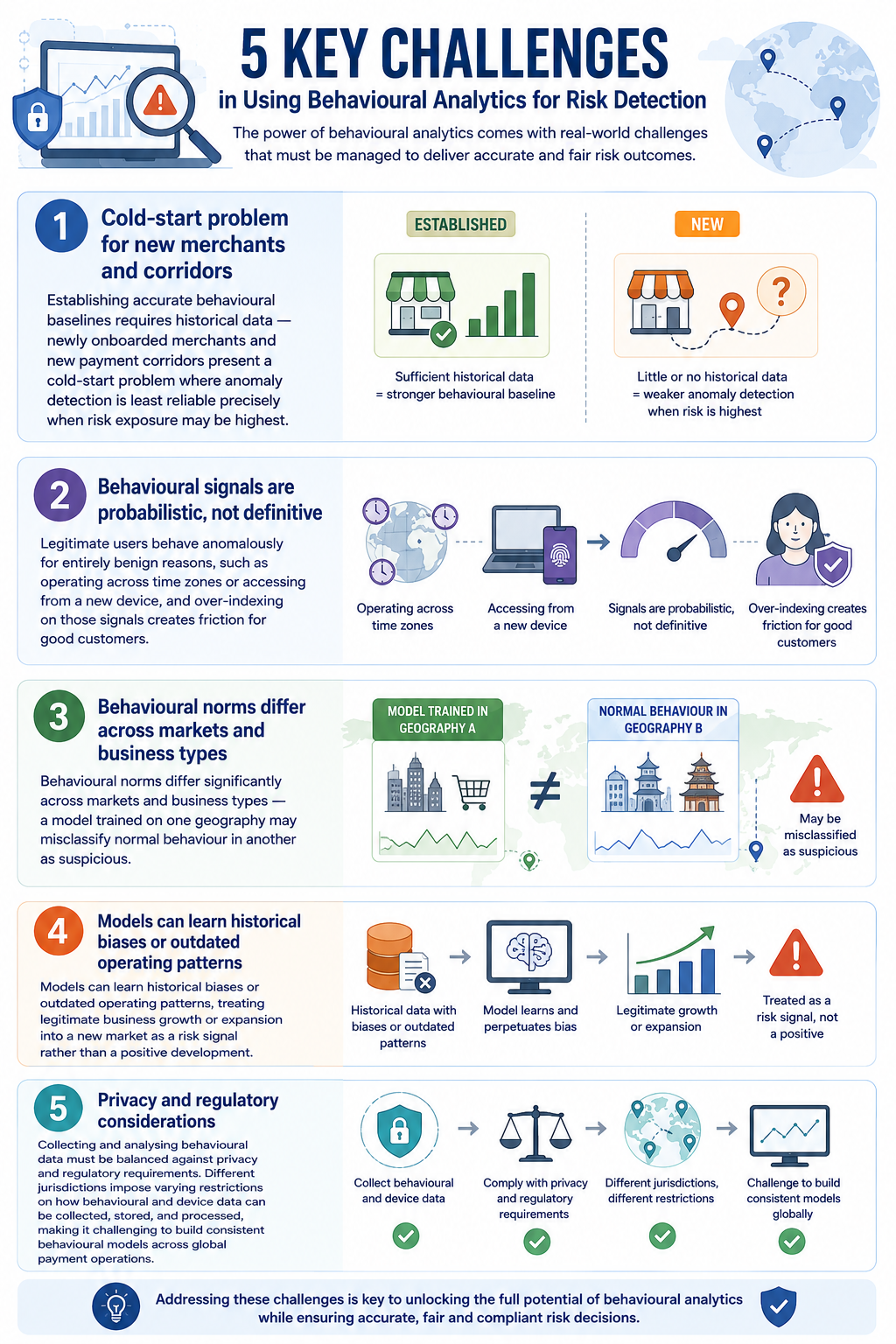
Rules-based systems were built for a simpler fraud landscape. They work well when the risk looks like risk that has already been seen. They struggle when fraud emerges through subtle combinations of behavioural, transactional, and network-level signals, which are patterns that fall just below individual rule thresholds but collectively indicate something is wrong.
The structural limitations compound at scale:
• At high transaction volumes, static rules generate significant false-positive rates, creating operational friction for legitimate payments and eroding the customer experience.
• Rules cannot adapt to changing fraud tactics without manual intervention. In an environment where attack patterns evolve continuously, the lag between a new pattern emerging and the corresponding rule being updated creates a window of genuine exposure.
• Cross-border B2B payments introduce multi-jurisdictional complexity that static rules handle poorly. For example, a transaction that triggers a flag in one corridor may be entirely routine in another, and rules rarely capture that nuance with sufficient accuracy.
Thus, the future model is not rules versus AI. It is likely rules augmented by adaptive analytics and contextual investigation, each handling what it does best.
Behavioural analytics changes the question risk systems are asking. Rather than "does this transaction match a known fraud pattern?", it asks: "does this transaction, user, or counterparty behave differently from how they normally behave?" That distinction allows it to surface novel fraud, account takeover, and insider risk in ways that rules cannot. This is due to its sensitivity to deviation from a baseline, not just similarity to a template.
In practice, this means continuous monitoring at the session level and entity level, not just at the point of transaction initiation. Anomalies in how a user navigates a payment platform, how a merchant's transaction volumes shift over time, or how a counterparty's payment behaviour changes relative to its historical pattern can all surface risk signals before a fraudulent transaction completes.
Behavioural analytics identifies the signal. Agentic AI acts on it. A conventional AI risk system assigns a score or generates an alert. An agentic system can investigate the signal, gather supporting evidence, apply the relevant policy, and coordinate a proportionate response.
This automatically resolves low-risk cases while escalating high-value or ambiguous decisions to a human reviewer. The distinction matters because the speed of intervention in payment risk is often what determines whether a fraudulent payment is stopped or settled.
This shift introduces governance requirements that must be designed in from the start:
• Autonomous intervention in payment workflows raises accountability questions. For instance, when an agentic system halts a legitimate payment, the business consequences can be material, and the chain of reasoning behind that decision must be reconstructable.
• Agentic systems operating across multiple tools and data sources require strict permission boundaries, which are the same autonomy that makes them powerful in risk management creates systemic exposure if those boundaries are not carefully defined and maintained.
• Human oversight remains essential for high-value and high-ambiguity decisions, especially when designing the right handoff points between autonomous AI action and human review as it is one of the most important and least standardised aspects of agentic risk system design.
The most significant capability emerges when behavioural analytics and agentic AI operate together as a closed loop rather than as separate tools.
Behavioural analytics without autonomous response capability still requires human intervention to act on what it detects — which reintroduces the latency problem that rules-based systems face. Agentic AI without rich behavioural signal risks acting on incomplete context, generating interventions that are technically correct but operationally inappropriate. Together, they close the loop: continuous monitoring surfaces anomalies, agentic reasoning evaluates them in context, and autonomous action responds within the transaction window.
Building this integrated capability requires investment in three foundational areas:
• Clean, real-time, cross-system data flows that connect behavioural analytics outputs to agentic AI decision logic. Without this infrastructure, the two systems cannot operate in genuine coordination.
• Deliberate logging and explainability architecture so that when an agentic AI acts on a behavioural signal, the chain of reasoning is reconstructable for compliance and regulatory review.
• Organisational readiness whereby risk teams who got accustomed to reviewing flags and approving interventions, must adapt to a model where their role shifts toward system oversight, threshold-setting, and exception management.
The role of the risk professional is not removed by this shift. It moves upward. Analysts spend less time gathering evidence and processing routine alerts, and more time defining policies, validating models, calibrating thresholds, investigating complex cases, and governing the system itself. The operational burden of transaction-level review shifts to the system; the human contribution shifts toward the judgements that autonomous systems are not yet equipped to make reliably.
Three practical priorities follow from this:
• Calibrating AI autonomy by transaction type
What is appropriate for a routine low-value domestic payment is not appropriate for a high-value cross-border transfer involving a new counterparty, and that distinction must be actively maintained as transaction profiles evolve.
• Tracking the regulatory horizon
Expectations around AI in payment risk management are evolving at different speeds across jurisdictions, and risk teams must understand how AI governance, privacy, data localisation, and automated decision-making requirements apply in each market where the system operates.
• Building for talent scarcity
Agentic risk systems require a combination of risk domain expertise and AI engineering capability that is genuinely difficult to source and retain, which means architecture decisions should reduce ongoing maintenance burden, not increase it.
Looking ahead
The convergence of agentic AI and behavioural analytics is not an incremental improvement to payment risk management. It is a structural shift in where risk intelligence sits, how it is generated, and how it is acted upon.
Businesses that build this capability with appropriate governance and data foundations will process payments with greater confidence, lower fraud loss rates, and a stronger compliance posture than those still relying on rules-based systems and manual review queues. The best-positioned organisations will not wait for fully autonomous risk management to be validated before beginning. They will start now with bounded, auditable use cases and expand autonomy only as performance and controls prove reliable.

To get started and partner with a solutions provider that can help your business optimise payments and help you scale both locally and globally, open a SUNRATE account today or contact our sales team.
Share to


When e-commerce scaled in the early 2000s, the infrastructure providers that captured disproportionate value were not the ones with the most merchants or the most consumer relationships. They were the ones that built the payment rails, the fraud detection networks, and the settlement infrastructure that every merchant and every transaction depended on. The value flowed […]


The shift toward autonomous agentic commerce is reshaping how B2B platforms handle value movement, buyer-seller discovery, and transaction execution. While consumer commerce relies on quick UI friction reduction, B2B procurement operates on structured approvals, complex credit arrangements, multi-currency treasury constraints, and rigorous compliance standards. As enterprise AI agents evolve from read-only research tools into active commerce […]
Across enterprise procurement functions, a pattern is emerging that should concern every CFO, CPO, and Head of Compliance paying attention. AI procurement agents — deployed to automate supplier discovery, purchase order generation, invoice matching, and payment initiation — are operating in production environments where the governance frameworks that should define, constrain, and audit their behaviour have not yet been established. This […]
We hope to use cookies to better understand your use of this website. This will help improve your future experience of accessing this website. For detailed information on the use of cookies and how to revoke or manage your consent, please refer to our < privacy policy >. If you click the confirmation button on the right, you will be deemed to have agreed to use cookies.


