
Not Every Currency Exposure Needs a Hedge. Knowing the Difference Is Where Treasury Strategy Starts.
Most treasury teams managing cross-border payment operations know they have FX exposure. Fewer have a systematic framework for deciding which exposures justify the cost and complexity of a formal hedging policy — and which are better managed through operational discipline, natural offsets, or simply accepted as a cost of doing business in that market.
The default response to this uncertainty is usually one of two extremes: hedge everything, or hedge nothing. Neither is right. Hedging every currency exposure incurs costs — in hedging instrument premiums, in the operational overhead of managing hedging positions, and in the foregone upside when currency movements favour the unhedged position. Hedging nothing accepts volatility that, in some corridors, is predictable enough and material enough to be genuinely managed rather than absorbed.
The middle path which identifies which currency corridors deserve a hedging policy and which do not, requires a structured analytical framework.
The Four Variables That Determine Whether a Corridor Deserves a Hedging Policy
Before building a framework, it is worth being precise about what makes a currency corridor a hedging candidate. Four variables determine this — and the answer changes as the business evolves.
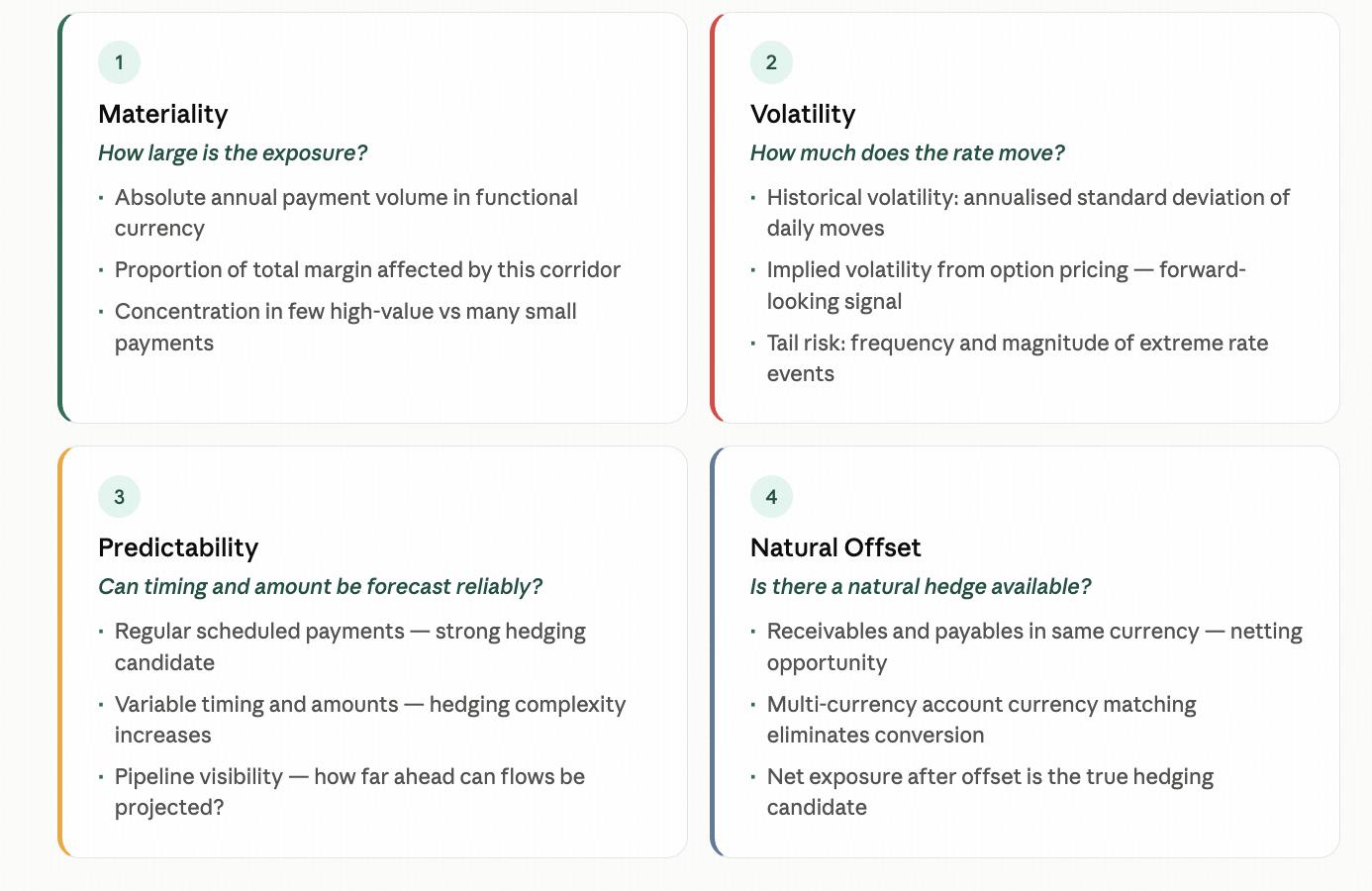
Variable 1: Materiality — how large is the exposure?
A currency corridor that accounts for 0.5% of annual payment volume does not warrant the same hedging consideration as one that accounts for 25%. Materiality is the starting filter — corridors below a defined materiality threshold are candidates for operational management rather than formal hedging policy.
Materiality should be measured in three ways simultaneously:
• Absolute value: the total annual payment volume through the corridor in functional currency terms
• Margin percentage: the proportion of the business's margin that is denominated in or affected by this currency
• Concentration: whether the exposure is spread across many transactions or concentrated in a small number of high-value payments
A corridor that appears immaterial by absolute value may be material by margin percentage — particularly in businesses where a specific market drives disproportionate profitability.
A corridor that appears immaterial by absolute value may be material by margin percentage, particularly in businesses where a specific market drives disproportionate profitability.
Variable 2: Volatility — how much does the rate move?
High-volume exposure in a currency pair with low historical volatility presents a different hedging case than moderate-volume exposure in a highly volatile pair. Volatility determines the range of outcomes that the unhedged position faces and therefore, the potential benefit of removing that uncertainty through hedging.
Relevant volatility measures include:
• Historical volatility: the annualised standard deviation of daily rate movements over a defined lookback period
• Implied volatility: the market's forward-looking expectation of volatility, reflected in option pricing
• Tail risk: the frequency and magnitude of extreme rate movements — the specific events that create the largest unhedged losses
Variable 3: Predictability — how reliably can the timing and amount of the exposure be forecast?
Hedging works best when the amount and timing of a future cash flow can be reliably predicted. A business that knows it will need to convert $2 million to JPY on the last business day of each month is a strong hedging candidate for that flow. A business with highly variable payment timing and amounts faces a more complex hedging problem and may find that the operational cost of managing a hedging position against unpredictable flows exceeds the benefit.
Variable 4: Natural offset — does the corridor have a natural hedge?
A currency corridor where receivables and payables are denominated in the same currency provides a natural hedging opportunity — using one to offset the other within a multi-currency account, without the cost of a formal hedging instrument. Before evaluating formal hedging policy for any corridor, the natural offset position should be assessed: how much of the gross exposure can be netted through currency matching?
The Corridor Prioritisation Matrix
Once the four variables have been assessed for each currency corridor, the next step is combining them into a prioritisation decision. The corridor prioritisation matrix does this by scoring each corridor on two composite dimensions — exposure significance and hedging tractability and plotting the result.
Exposure significance combines materiality and volatility: a corridor with high-volume exposure and high currency volatility has high exposure significance. A corridor with low-volume exposure and low volatility has low exposure significance.
Hedging tractability combines predictability and natural offset: a corridor with predictable cash flows and limited natural offset is highly tractable for hedging. A corridor with unpredictable flows and significant natural offset has lower tractability — the natural offset reduces the net exposure, and the unpredictability makes formal hedging instruments harder to size correctly.
From Prioritisation to Policy
The matrix should be treated as a decision framework, not a one-time classification exercise.
Corridor Prioritisation Matrix

Once priority corridors have been identified, treasury can define the policy governing them. This should establish the proportion of forecast exposure to hedge, permitted instruments, hedge horizons, limits, approval requirements and the circumstances that trigger a review.
Review the Corridors, Not Just the Hedge Positions
A common weakness in FX management is reviewing existing hedge positions without reassessing whether the underlying corridor still deserves the same treatment.
Exposure changes as businesses enter new markets, shift supplier relationships, change payment currencies or alter settlement structures. A corridor that was once low significance can become strategically important as payment volumes grow. Conversely, a corridor that once justified formal hedging may become less significant after natural offsets develop.
Hedge the Exposure That Matters
A strong FX hedging strategy begins before a hedge is placed. It starts with understanding which currency corridors create meaningful economic exposure, how volatile those exposures are, how reliably they can be forecast and how much can be offset naturally.
This provides treasury teams with a more defensible answer to a fundamental question: not “Should we hedge FX?”, but “Which exposures are worth managing formally, and why?”
Formal hedging should be targeted at exposures where volatility is material, cash flows are sufficiently predictable and the benefit of reducing uncertainty justifies the cost and operational complexity.
For other corridors, disciplined monitoring, natural offsets and operational controls may be the more efficient approach. As payment volumes, market footprints and exposure profiles evolve, the classification can evolve with them.

To get started and partner with a solutions provider that can help your business optimise payments and help you scale both locally and globally, open a SUNRATE account today or contact our sales team.
Share to


When e-commerce scaled in the early 2000s, the infrastructure providers that captured disproportionate value were not the ones with the most merchants or the most consumer relationships. They were the ones that built the payment rails, the fraud detection networks, and the settlement infrastructure that every merchant and every transaction depended on. The value flowed […]


The shift toward autonomous agentic commerce is reshaping how B2B platforms handle value movement, buyer-seller discovery, and transaction execution. While consumer commerce relies on quick UI friction reduction, B2B procurement operates on structured approvals, complex credit arrangements, multi-currency treasury constraints, and rigorous compliance standards. As enterprise AI agents evolve from read-only research tools into active commerce […]
Across enterprise procurement functions, a pattern is emerging that should concern every CFO, CPO, and Head of Compliance paying attention. AI procurement agents — deployed to automate supplier discovery, purchase order generation, invoice matching, and payment initiation — are operating in production environments where the governance frameworks that should define, constrain, and audit their behaviour have not yet been established. This […]
We hope to use cookies to better understand your use of this website. This will help improve your future experience of accessing this website. For detailed information on the use of cookies and how to revoke or manage your consent, please refer to our < privacy policy >. If you click the confirmation button on the right, you will be deemed to have agreed to use cookies.


