
A supplier payment is initiated, executed and settled. Later, the finance director asks a simple question: who authorised it, under what authority, and what exactly were they authorising?
In a manual payment environment, the answer is usually straightforward. A named employee reviews the transaction, approves it within an established authority limit, and the approval is recorded. But as B2B payment operations become increasingly automated, that chain of evidence is becoming harder to establish.
An automated procurement platform, treasury system or AI agent may initiate a payment based on permissions granted weeks or months earlier. The system is acting within a set of rules, but the resulting transaction may never have been individually reviewed by a human. This creates a governance gap.
How B2B Payment Authorisation Works — and Why It Is Becoming Insufficient
Most B2B payment environments rely on familiar controls: spending limits assigned by role, dual approval for higher-value payments, supplier whitelists and escalation for unusual transactions.
These controls remain useful, but they were largely designed around a human being making a contextual decision at the point of payment. Automation changes that assumption.
• Amount limits alone are too broad: They may define how much can be paid, but not what for, to whom, where or when.
• Dual authorisation loses context: An automated system may initiate the payment, making its action difficult to equate with human judgement.
• Static supplier whitelists are limited: They identify approved counterparties but may not define whether a payment is authorised for a specific purpose, corridor, currency or period.
• The core issue: Existing controls were designed for human-led decision-making. Automated payments require permissions that define not only who can approve, but what systems can do on their behalf.
What Granular Permissions Actually Mean in B2B Payments
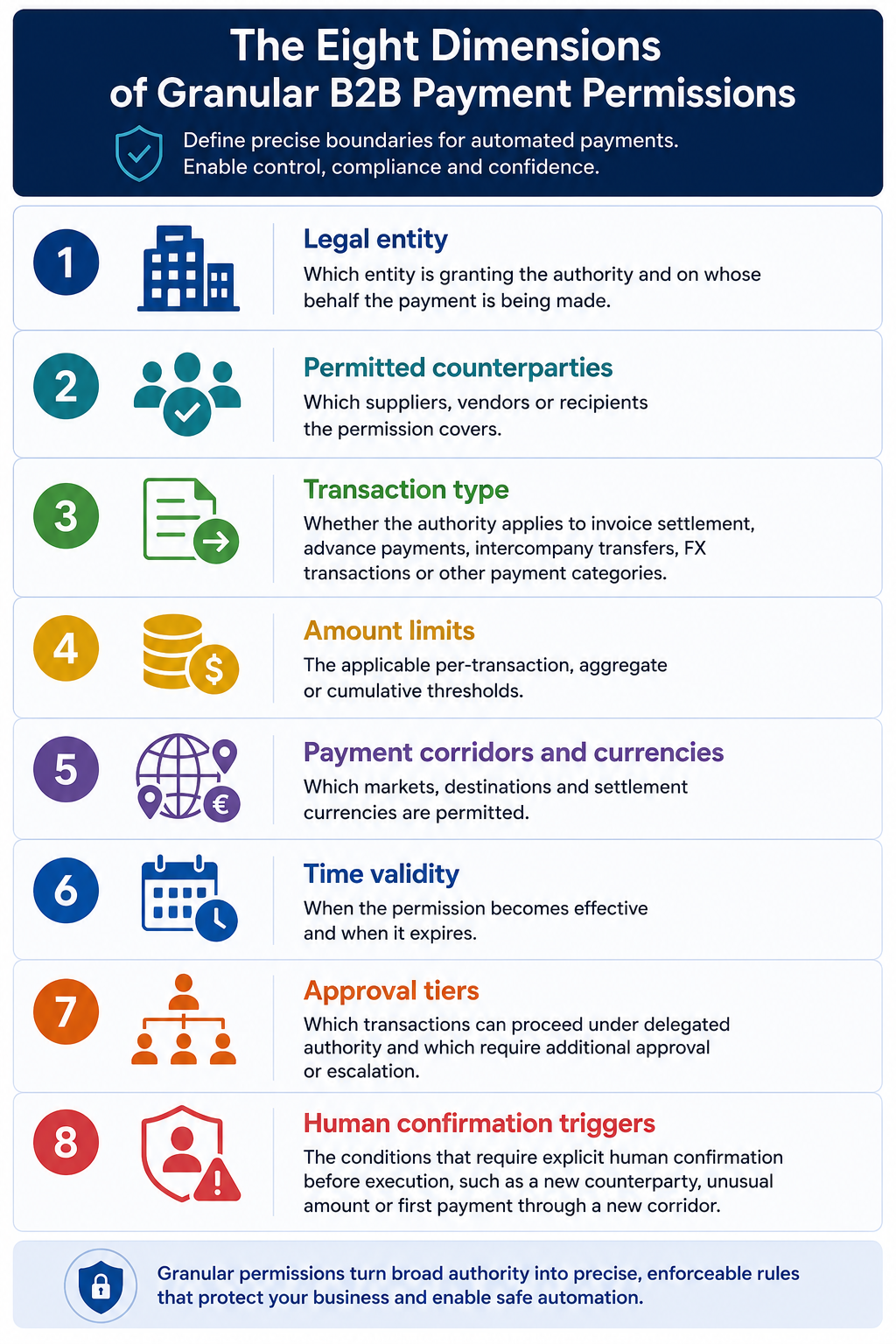
Granular permissions are structured authorisations that define the specific conditions under which a payment action is permitted. Instead of treating authority as a broad entitlement, they create a permission matrix that can be evaluated before execution.
What Structured Consent Flows Add
Granular permissions define the boundaries of authority. Structured consent establishes how that authority is granted, understood, recorded and withdrawn.
This distinction matters because a conventional approval workflow is not necessarily a consent mechanism for autonomous payment activity.
Approval is typically a point-in-time action: an individual reviews a payment and clicks to approve it. It does not necessarily document the broader permissions under which an automated system may act across subsequent transactions.
A structured consent flow instead requires the authorising party to make an explicit, informed and specific decision about the permissions being delegated.
• Explicit consent means the authoriser actively grants the defined authority rather than passively accepting broad terms.
• Informed consent means the scope is clearly presented before authorisation, including relevant counterparties, transaction types, limits, corridors and validity periods.
• Specific consent means the permission is tied to defined conditions rather than interpreted as a general mandate to act.
• Documented consent means the system records who granted the authority, when it was granted, what was authorised and how the decision was made.
• Revocable consent means the authoriser can modify or withdraw the permission, with the change reflected in the execution layer.
Consider a treasury team delegating FX execution to an AI agent. Rather than simply granting the agent access to an FX account, the consent flow could define permitted currency pairs, transaction limits, operating periods and conditions that require human intervention.
The resulting authorisation becomes an explicit governance object that the system can enforce and the organisation can audit.
This is the fundamental difference: structured consent is not an approval workflow with additional steps. It is the mechanism for establishing the authority within which an automated system is allowed to operate.
The Regulatory Direction
Granular permissions should not yet be described as a universal regulatory requirement across B2B payments. Requirements differ by jurisdiction, institution and use case. However, the regulatory direction is increasingly aligned with the underlying principles: clear accountability, effective human oversight, traceability and controls over automated financial activity.
• MAS: Technology risk guidance reinforces the need for governance, accountability and effective technology controls.
• EU AI Act: Introduces human-oversight requirements for high-risk AI systems, although not every payment-related AI system falls into this category.
• HKMA: Its focus on operational resilience and technology governance reinforces the need to understand and control automated processes.
• Industry protocols: Initiatives such as Google's AP2 and Visa's Trusted Agent Protocol are formalising concepts such as verifiable agent identity, mandates and transaction-specific authorisation.
• The emerging direction: Payment authorisation is moving towards permissions that can be digitally defined, verified and enforced, rather than inferred from broad account access.
For B2B payment operators, the practical implication is clear. Permission frameworks should be specific enough to demonstrate that an automated action was within authorised scope. Consent records should provide evidence of that authorisation. Escalation rules should identify when human intervention is required, while revocation should be enforceable rather than merely documented.
A useful starting point is to map existing payment controls against the eight permission dimensions above. Any dimension that cannot be clearly defined, enforced or evidenced represents a potential governance gap as automation increases.
Building Granular Permissions Into Payment Infrastructure
Implementing this model requires more than adding another approval screen. Granular permissions need to be built into the payment architecture itself.
• The permission definition layer captures the conditions under which each automated payment authorisation is valid.
• The consent interface layer allows authorised individuals to understand, approve and modify those permissions without needing to interpret technical rules.
• The execution enforcement layer evaluates each automated payment against the current permission set before execution, blocking or escalating transactions that fall outside scope.
• The audit and reporting layer records permission grants, consent actions, payment evaluations, escalation events and subsequent changes.
These layers need to operate as a connected control system. A permission that is defined but not enforced is only a policy. A consent action that is not recorded is difficult to evidence.
An audit trail that does not reflect the permission state at execution cannot reliably demonstrate why a transaction was allowed.
The Permission Layer Is Becoming the Trust Layer
As B2B payment initiation shifts from people towards systems, the question of trust changes with it.
The important question is no longer simply whether a payment executed correctly. It is whether the system that initiated it was authorised to do so, within a permission that was specific, current and properly granted.
Granular permissions and structured consent flows provide the infrastructure for answering that question. They do not eliminate the need for human judgement, compliance controls or payment security. Instead, they define where human authority ends and automated execution begins — and create a verifiable record of that boundary.
The future of B2B payments is not simply more autonomous execution. It is autonomous execution operating within permissions that are precise enough to trust, enforce and prove.
To get started and partner with a solutions provider that can help your business optimise payments and help you scale both locally and globally, open a SUNRATE account today or contact our sales team.
Share to


When e-commerce scaled in the early 2000s, the infrastructure providers that captured disproportionate value were not the ones with the most merchants or the most consumer relationships. They were the ones that built the payment rails, the fraud detection networks, and the settlement infrastructure that every merchant and every transaction depended on. The value flowed […]

The shift toward autonomous agentic commerce is reshaping how B2B platforms handle value movement, buyer-seller discovery, and transaction execution. While consumer commerce relies on quick UI friction reduction, B2B procurement operates on structured approvals, complex credit arrangements, multi-currency treasury constraints, and rigorous compliance standards. As enterprise AI agents evolve from read-only research tools into active commerce […]
Across enterprise procurement functions, a pattern is emerging that should concern every CFO, CPO, and Head of Compliance paying attention. AI procurement agents — deployed to automate supplier discovery, purchase order generation, invoice matching, and payment initiation — are operating in production environments where the governance frameworks that should define, constrain, and audit their behaviour have not yet been established. This […]
We hope to use cookies to better understand your use of this website. This will help improve your future experience of accessing this website. For detailed information on the use of cookies and how to revoke or manage your consent, please refer to our < privacy policy >. If you click the confirmation button on the right, you will be deemed to have agreed to use cookies.


