
The systems designed to make financial decisions more efficient and consistent can encode historical patterns and apply them at a scale no individual decision-maker could replicate. That is the central paradox of AI in financial services and it is one that the industry has not yet fully reckoned with.
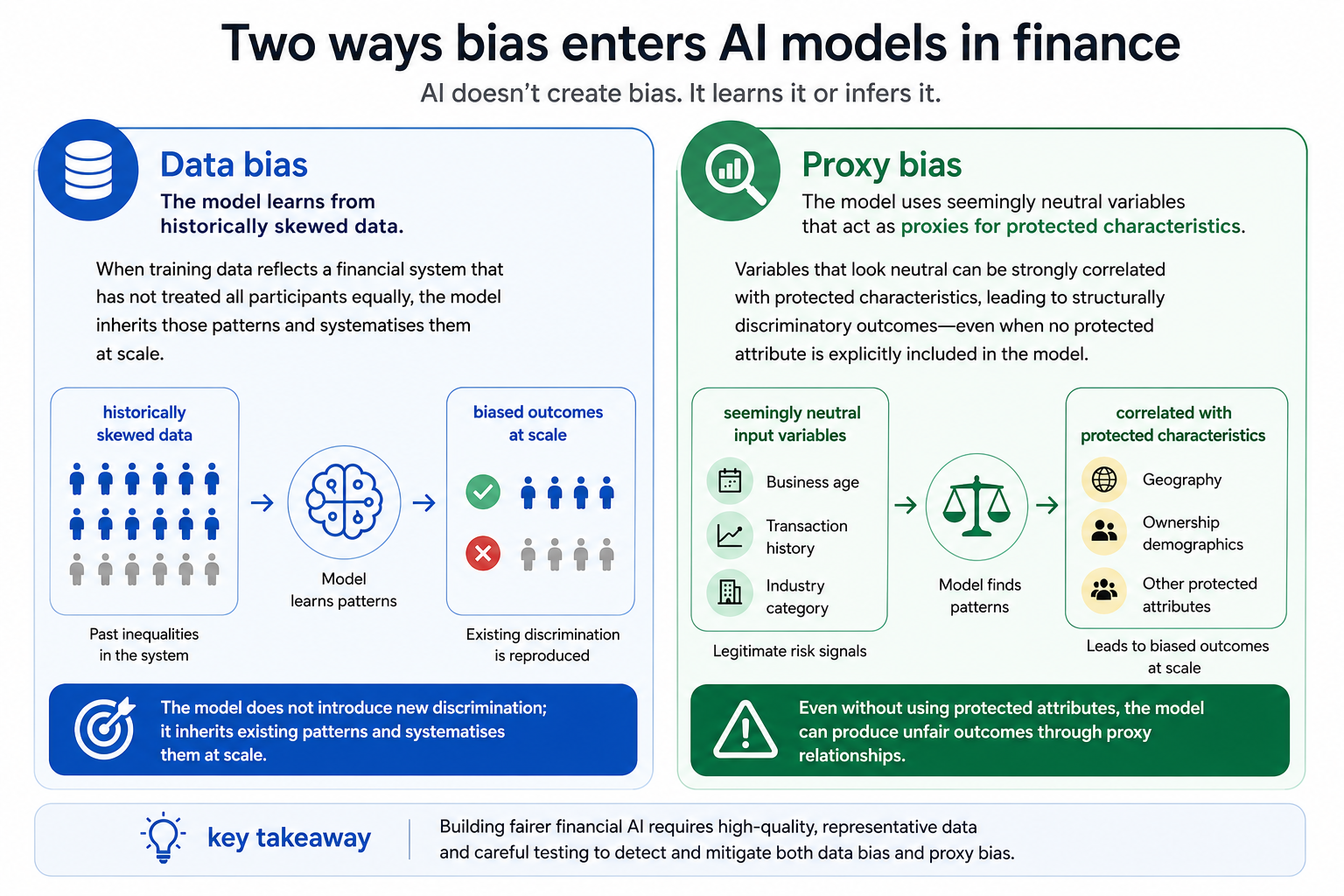
Before addressing how AI bias manifests in financial systems, it helps to be precise about what bias means in this context. Two distinct types are most relevant.
Managing AI bias in financial transactions is not solely a model-development problem. It is a lifecycle governance challenge requiring appropriate data controls, disaggregated testing, meaningful human oversight, transparent escalation, and continuous monitoring.
AI bias in financial systems is not typically deliberate as it is inherited. Models trained on historical transaction data absorb the patterns of a financial system that has not treated all participants equally. When those patterns are encoded into automated decisioning, they are not merely preserved. They are systematised, scaled, and rendered invisible behind an appearance of algorithmic objectivity.
The mechanisms through which bias enters financial AI systems are specific and worth naming:
• Fraud detection models trained predominantly on transaction data from established markets may systematically flag legitimate transactions from underrepresented populations as anomalous. The false positive rate rises for specific customer segments without any individual decision ever being consciously made.
• Cross-border payment routing systems may deprioritise or impose additional scrutiny on certain currency corridors or originating geographies, not because the counterparty risk is higher, but because historical data reflects regulatory differences or infrastructure gaps that have since been addressed.
• Credit and payment limit decisioning that uses proxy variables such as business age or industry category can produce outcomes that correlate with geography or ownership demographics in ways that are statistically valid but structurally discriminatory.
• Feedback loops compound the problem: when a biased model generates adverse decisions, those decisions reduce the future data available from affected groups, making the next model iteration more biased still.
The challenge with AI bias in financial transactions is not that it is invisible — it is that it hides inside outcomes that look correct from the outside. A fraud detection model that flags 3% of transactions may be performing exactly as designed, even if that 3% is drawn disproportionately from a specific customer segment. Without disaggregated performance analysis by demographic and corridor, the bias is statistically present but operationally invisible.
Several structural factors allow bias to persist in financial AI systems:
• Models are typically evaluated on aggregate performance metrics such as overall accuracy, false positive rates and payment hold rates, that can look strong even when the model performs significantly worse for specific subgroups.
• The proprietary nature of many financial AI systems limits the ability of compliance teams, regulators, and affected customers to interrogate decision logic.
• Bias in cross-border payment AI is further obscured by the legitimate complexity of international risk. Thus, it can be genuinely difficult to distinguish between a model that has learned appropriate corridor-level risk signals and one that has learned to discriminate on the basis of geography as a proxy for other characteristics.
Human oversight in financial AI is most valuable not when it catches a specific wrong decision, but when it creates the feedback loop through which bias is identified, documented, escalated, and corrected before it becomes systemic. The human reviewer who flags a pattern of anomalous decisions in a specific corridor is not just correcting a mistake as they are performing a bias detection function that the model itself cannot perform.
This reframes human oversight from a fallback mechanism to a structural design requirement. But realising that value requires addressing the ways in which oversight is currently under-designed:
Effective human oversight requires structured review protocols, clear escalation pathways, and disaggregated reporting that makes subgroup performance disparities visible before they become systemic failures.
Bias-aware financial AI is not achieved through a single technical intervention. From training data curation through deployment monitoring and ongoing model governance, it is the cumulative result of deliberate choices across the full model lifecycle. Organisations that treat bias mitigation as a deployment-stage checklist will find that bias returns as soon as conditions shift.
Practical design principles for finance and risk leaders include:
Examining historical datasets for systematic underrepresentation or historical discrimination is resource-intensive but foundational. A model built on skewed data will produce skewed outputs regardless of how well the model itself is designed.
Fairness objectives may create trade-offs with aggregate performance, operational cost, or risk sensitivity. These trade-offs should be explicitly evaluated and governed rather than assumed to be unavoidable or ignored because they are uncomfortable to discuss.
Ongoing bias monitoring requires investment in reporting infrastructure that captures subgroup performance, dedicated analytical capacity to interpret it, and clear escalation pathways when disparities emerge.
Regulatory expectations around explainability in AI financial decisions are increasing across jurisdictions. Compliance teams should work with AI and data science colleagues to develop documentation and audit capabilities that meet regulatory intent even where technical standards are still developing.
Regulatory frameworks for AI bias in financial services are converging on a common expectation: that financial institutions can demonstrate not just that their AI systems comply with existing anti-discrimination obligations, but that they have taken proactive steps to identify, monitor, and mitigate bias throughout the model lifecycle.
The EU AI Act classifies credit scoring and fraud detection as high-risk AI applications subject to mandatory conformity assessments, transparency obligations, and human oversight requirements. Financial institutions operating in the EU need to map existing AI deployments against these obligations now, not when enforcement begins.
Cross-border financial institutions face additional complexity. What satisfies the EU AI Act may not satisfy emerging frameworks in Singapore, the UK, or other regions requiring flexible governance architectures rather than single-standard compliance. Institutions that build robust bias detection and human oversight infrastructure now will be better positioned to meet explicit regulatory requirements as they arrive, rather than retrofitting controls under regulatory pressure.
AI in financial transactions does not arrive neutral. The organisations that treat that fact as a design requirement, rather than a risk disclaimer appended to a model card, are the ones building systems that are genuinely trustworthy at scale.
As AI decision-making authority in financial services expands, the gap between organisations with robust bias detection and human oversight infrastructure and those without it will become increasingly visible: to regulators scrutinising model governance, to customers experiencing the outcomes of biased systems, and to the markets that price institutional risk. Building that infrastructure is not a future obligation. It is a present one.

To get started and partner with a solutions provider that can help your business optimise payments and help you scale both locally and globally, open a SUNRATE account today or contact our sales team.
Share to



When e-commerce scaled in the early 2000s, the infrastructure providers that captured disproportionate value were not the ones with the most merchants or the most consumer relationships. They were the ones that built the payment rails, the fraud detection networks, and the settlement infrastructure that every merchant and every transaction depended on. The value flowed […]


The shift toward autonomous agentic commerce is reshaping how B2B platforms handle value movement, buyer-seller discovery, and transaction execution. While consumer commerce relies on quick UI friction reduction, B2B procurement operates on structured approvals, complex credit arrangements, multi-currency treasury constraints, and rigorous compliance standards. As enterprise AI agents evolve from read-only research tools into active commerce […]

Across enterprise procurement functions, a pattern is emerging that should concern every CFO, CPO, and Head of Compliance paying attention. AI procurement agents — deployed to automate supplier discovery, purchase order generation, invoice matching, and payment initiation — are operating in production environments where the governance frameworks that should define, constrain, and audit their behaviour have not yet been established. This […]
We hope to use cookies to better understand your use of this website. This will help improve your future experience of accessing this website. For detailed information on the use of cookies and how to revoke or manage your consent, please refer to our < privacy policy >. If you click the confirmation button on the right, you will be deemed to have agreed to use cookies.


