
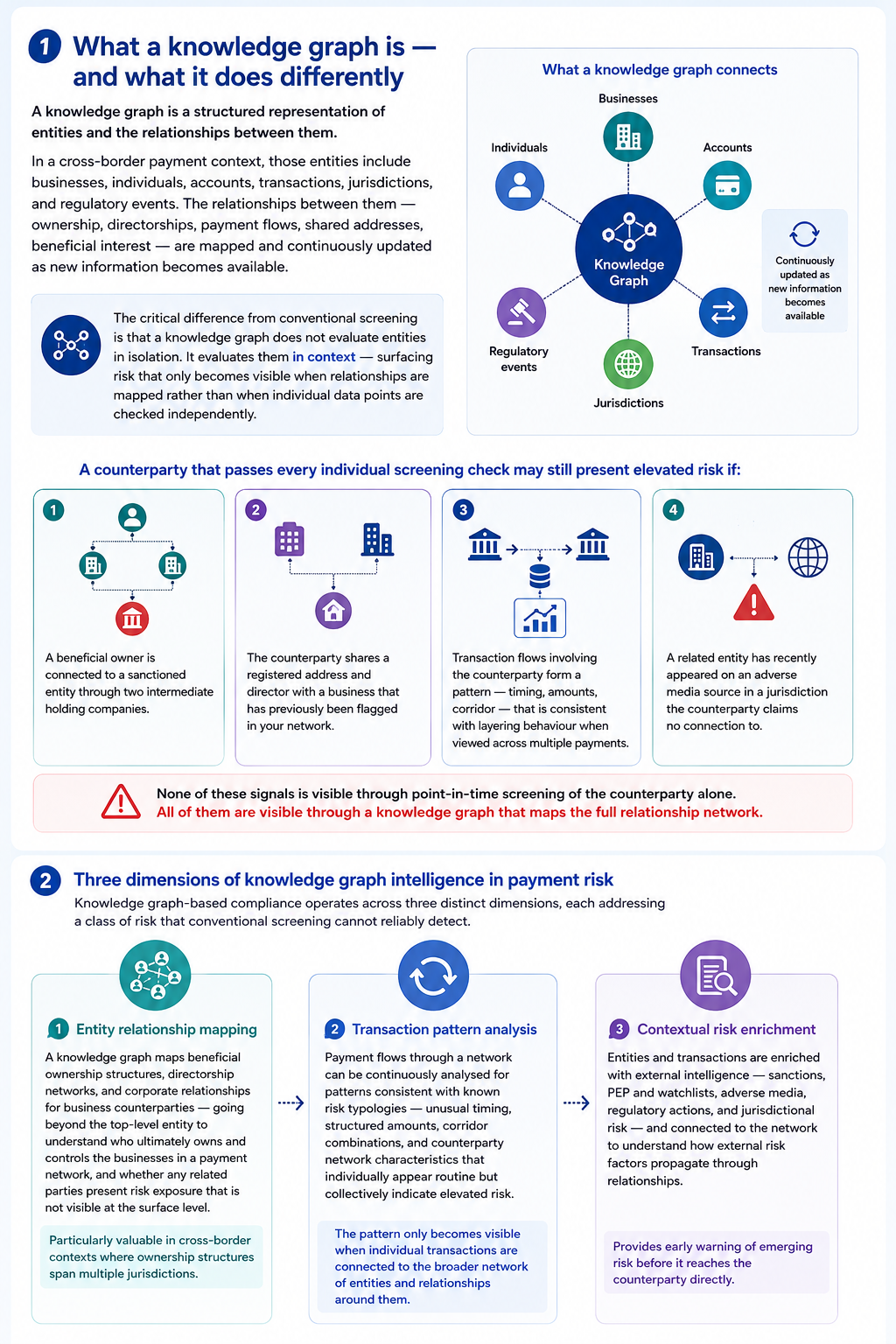
Cross-border payment risk is rarely simple. The counterparty on the other side of a transaction is not just a name and a bank account — it is a web of relationships, ownership structures, transaction histories, geographic exposures, and regulatory contexts that conventional screening tools were not designed to map. Knowledge graphs are changing that.
The limitation of point-in-time screening
Traditional compliance screening works on a snapshot basis. At the point of onboarding or transaction initiation, a counterparty is checked against sanctions lists, PEP databases, and adverse media sources. If nothing flags, the transaction proceeds. If something flags, a human reviewer investigates.
The limitation is structural. A snapshot tells you what is known about a counterparty at a single moment in time. It does not tell you:
• How that counterparty is connected to other entities in your payment network
• Whether a related party — a shareholder, a director, a subsidiary — has exposure that the counterparty itself does not
• How risk signals that appear unrelated in isolation combine into a pattern that warrants attention
• How the counterparty's risk profile has evolved since onboarding
In cross-border B2B payments, where counterparty relationships are complex, jurisdictions vary significantly, and beneficial ownership structures can span multiple layers across multiple geographies, point-in-time screening misses precisely the risks that matter most.
Why this matters for cross-border payments specifically
Cross-border payment risk presents challenges that domestic payment risk does not. The complexity of beneficial ownership structures is greater across jurisdictions. Regulatory events in one market can have implications for counterparties in another. Correspondent banking chains introduce intermediaries whose own risk profiles are relevant to the payment. And the volume and geographic distribution of transactions makes manual relationship mapping impractical at scale.
Knowledge graphs address these challenges directly because their value increases with the complexity and volume of the network they map. The more entities, relationships, and transactions are represented in the graph, the more complete the picture of risk — and the more accurately the system can distinguish between genuine risk signals and coincidental connections that do not warrant escalation.
For businesses managing cross-border payment flows across multiple markets, this means compliance decisions can be made with a richer, more accurate understanding of counterparty risk than point-in-time screening provides — reducing both the rate of false positives that create unnecessary friction and the rate of false negatives that allow genuine risk to pass undetected.
The human oversight layer
Knowledge graph intelligence is most powerful when combined with human expertise rather than substituting for it. The most effective compliance architectures use the knowledge graph to surface and contextualise risk signals, and route complex or high-risk cases to human compliance specialists who apply judgement to the full picture the system has assembled.
This human-in-the-loop design serves two purposes. The first is accuracy: complex beneficial ownership assessments and novel risk patterns benefit from human analysis that draws on regulatory expertise and contextual knowledge an automated system alone cannot replicate. The second is accountability: in a regulated environment, material compliance decisions require human sign-off that is documentable, auditable, and defensible to regulators.
The knowledge graph changes what the human reviewer is doing. Rather than spending time assembling relationship information from multiple sources — a process that is slow, inconsistent, and dependent on the individual reviewer's knowledge of where to look — the reviewer works with a structured, pre-assembled picture of the risk context that the system has built and continuously maintained. That shift in workload allocation is where the efficiency gains are most significant: not in removing human judgement from the compliance process, but in ensuring that human judgement is applied to analysis rather than administration.
Building knowledge graph capability into payment compliance
For compliance and risk leaders evaluating whether knowledge graph intelligence is the right investment for their payment operations, three questions are worth asking:
• What proportion of our cross-border counterparties have multi-jurisdictional ownership structures? The more complex the beneficial ownership landscape, the greater the gap between what point-in-time screening can see and what a knowledge graph reveals.
• Are we currently detecting risk at the network level, or only at the entity level? If the answer is entity-level only, the patterns that connect individual counterparties into networks of related risk are invisible to your compliance function.
• How quickly does a change in a related entity's risk status propagate to our compliance posture? If the answer is slowly or not at all, the dynamic updating capability of a knowledge graph addresses a real and material gap.
The fundamental insight is that risk in cross-border payments is relational, not just individual. A counterparty's risk profile is shaped by who owns it, who it transacts with, what jurisdictions it operates in, and how its behaviour connects to the behaviour of other entities in the payment network. Building the infrastructure to see those relationships is not an advanced compliance ambition — it is an increasingly necessary baseline for managing cross-border payment risk at scale.
To get started and partner with a solutions provider that can help your business optimise payments and help you scale both locally and globally, open a SUNRATE account today or contact our sales team.
Share to


When e-commerce scaled in the early 2000s, the infrastructure providers that captured disproportionate value were not the ones with the most merchants or the most consumer relationships. They were the ones that built the payment rails, the fraud detection networks, and the settlement infrastructure that every merchant and every transaction depended on. The value flowed […]

The shift toward autonomous agentic commerce is reshaping how B2B platforms handle value movement, buyer-seller discovery, and transaction execution. While consumer commerce relies on quick UI friction reduction, B2B procurement operates on structured approvals, complex credit arrangements, multi-currency treasury constraints, and rigorous compliance standards. As enterprise AI agents evolve from read-only research tools into active commerce […]
Across enterprise procurement functions, a pattern is emerging that should concern every CFO, CPO, and Head of Compliance paying attention. AI procurement agents — deployed to automate supplier discovery, purchase order generation, invoice matching, and payment initiation — are operating in production environments where the governance frameworks that should define, constrain, and audit their behaviour have not yet been established. This […]
We hope to use cookies to better understand your use of this website. This will help improve your future experience of accessing this website. For detailed information on the use of cookies and how to revoke or manage your consent, please refer to our < privacy policy >. If you click the confirmation button on the right, you will be deemed to have agreed to use cookies.


