
Two Problems That Look the Same Until You Try to Solve Them
Every finance leader managing a global operation has a version of the same conversation with their board.
Currency movements affected the numbers. FX exposure created volatility in reported earnings. The cost of converting between currencies eroded margins in specific markets. The solution, the conversation implies, is better FX management.
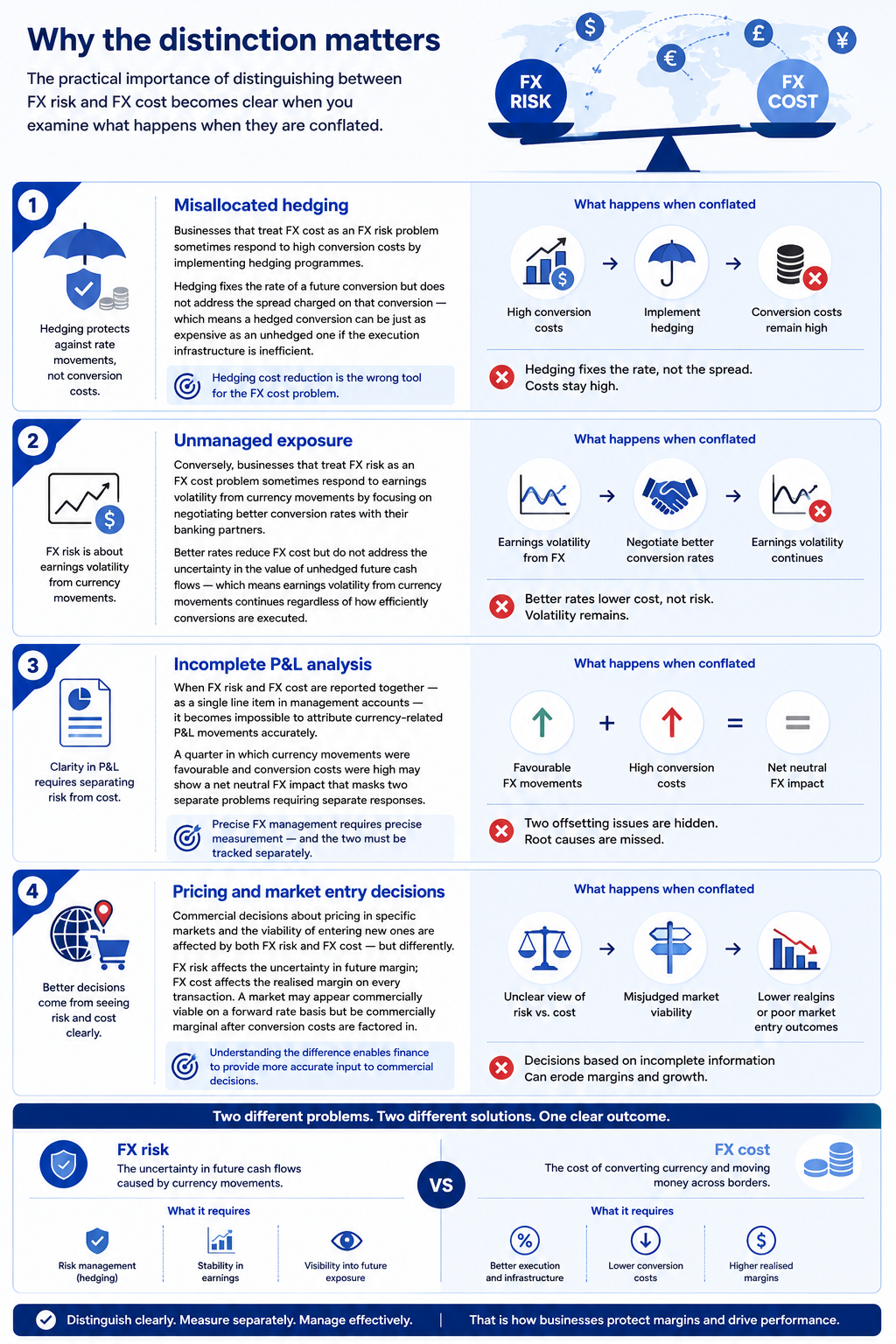
The problem with this conversation is that it conflates two distinct challenges — FX risk and FX cost — that require fundamentally different responses. Conflating them does not just produce imprecise diagnosis. It produces the wrong treatment: businesses that hedge when they should optimise, and optimise when they should hedge, and wonder why the FX problem never fully resolves.
FX risk and FX cost are related. They share a common origin in the fact that different parts of a global business operate in different currencies. But they are different problems, they manifest differently in financial statements, they affect different parts of the organisation, and they are addressed through different mechanisms. A business that understands this distinction manages its currency exposure more precisely, allocates its treasury resources more effectively, and makes better commercial decisions about pricing, market entry, and supplier relationships.
A business that does not understand this distinction treats every currency problem as the same problem — and never quite solves any of them.
What FX Risk Actually Is
FX risk is the exposure that arises when a business has future obligations or receivables denominated in a currency different from its reporting or functional currency, and the value of those future cash flows is uncertain because exchange rates will move between now and when those flows occur.
It is, fundamentally, a balance sheet and income statement problem. When a UK-based travel company contracts with a hotel group in Japan for room allocations at a price denominated in JPY, and the company's reporting currency is GBP, the company has a future JPY obligation whose GBP equivalent is unknown until the exchange rate at settlement is determined. If GBP weakens significantly against JPY between the contract date and the settlement date, the accommodation costs the company more in GBP terms than it budgeted — even though nothing about the underlying commercial arrangement has changed.
This is FX risk: the uncertainty in the GBP value of a future JPY cash flow. The risk exists regardless of whether any actual conversion has yet occurred. It exists in the gap between commitment and settlement, and it creates earnings volatility that is entirely separate from the operational performance of the business.
FX risk is managed through hedging — instruments and strategies designed to fix or bound the exchange rate at which a future cash flow will be converted, reducing the uncertainty in its functional currency value. Forward contracts, options, and natural hedging through revenue-cost currency matching are all responses to FX risk. They do not reduce the cost of conversion — they reduce the uncertainty of it.
What FX Cost Actually Is
FX cost is different. It is not the uncertainty in the value of future cash flows. It is the measurable, realised cost of the conversions that have already happened — the spread between the rate at which a conversion was executed and the rate that was available in the market at that moment, plus any explicit fees charged for the conversion itself.
FX cost is an operational cost, not a balance sheet risk. It is incurred at the moment of conversion and immediately affects the P&L. It does not create uncertainty — it creates an outcome that is either more or less expensive depending on how well the conversion was managed.
Consider the same UK travel company. When it actually pays the Japanese hotel group — converting GBP to JPY through its banking infrastructure — the rate at which that conversion executes compared to the interbank mid-market rate determines the FX cost. If the company's bank charges a 1.5% spread on the conversion, that 1.5% is FX cost — a direct reduction in the company's margin on that transaction, certain and immediate.
FX cost has nothing to do with hedging. The company may have perfectly hedged its JPY exposure and still incur significant FX cost if its conversion execution is inefficient. Conversely, a company with no hedging programme can have very low FX costs if its operational execution of currency conversions is disciplined and its banking infrastructure provides competitive rates.
Managing Each Problem With the Right Tool
Once the distinction is clear, the management framework follows logically.
FX risk is managed through exposure identification and hedging strategy. The first step is mapping the organisation's currency exposure — which future cash flows are denominated in which currencies, when they are expected to occur, and what the functional currency equivalent is at current rates. The second step is defining the organisation's risk appetite — how much earnings volatility from currency movements is acceptable, and over what time horizon. The third step is selecting hedging instruments proportionate to the exposure and the risk appetite — forward contracts for high-certainty future flows, options for flows where the amount or timing is uncertain, natural hedging where revenue and cost currencies can be matched.
FX cost is managed through execution discipline and infrastructure optimisation. The first step is measuring actual conversion costs — the spread between executed rates and interbank mid-market rates on every conversion, across every currency pair and every banking relationship. Most businesses that do this for the first time discover that their actual FX costs are significantly higher than their banking partners' advertised rates suggest — because the spread on any given conversion is determined by timing, liquidity conditions, and the specific terms of the banking relationship, not just the headline rate.
The second step is identifying the execution patterns that are driving unnecessary cost — conversions executed in low-liquidity windows, at suboptimal times, through banking relationships that offer worse spreads on specific currency pairs. The third step is implementing systematic execution discipline — defined conversion windows, corridor-specific banking relationships where the terms are most competitive, and where possible, the use of AI-driven execution that identifies and acts on optimal conversion windows continuously.
The Combined Advantage
The businesses that manage FX risk and FX cost as separate disciplines — with distinct measurement frameworks, distinct management tools, and distinct ownership within the finance function — consistently achieve better currency-related financial outcomes than those that treat them as a single problem.
They hedge more precisely because they know exactly what they are hedging and why — not as a general response to currency uncertainty but as a specific response to identified exposure with a defined risk tolerance. They execute more efficiently because they track conversion costs explicitly and have established the infrastructure and execution discipline to minimise them. And they make better commercial decisions because the currency-related inputs to those decisions — both the risk dimension and the cost dimension — are measured accurately and reported separately.
The FX conversation with the board does not need to be imprecise. Currency exposure is identifiable. Conversion costs are measurable. The tools for managing both exist and are accessible. The starting point is understanding that they are two different problems — and committing to solving each of them correctly.

To get started and partner with a solutions provider that can help your business optimise payments and help you scale both locally and globally, open a SUNRATE account today or contact our sales team.
Share to


When e-commerce scaled in the early 2000s, the infrastructure providers that captured disproportionate value were not the ones with the most merchants or the most consumer relationships. They were the ones that built the payment rails, the fraud detection networks, and the settlement infrastructure that every merchant and every transaction depended on. The value flowed […]


The shift toward autonomous agentic commerce is reshaping how B2B platforms handle value movement, buyer-seller discovery, and transaction execution. While consumer commerce relies on quick UI friction reduction, B2B procurement operates on structured approvals, complex credit arrangements, multi-currency treasury constraints, and rigorous compliance standards. As enterprise AI agents evolve from read-only research tools into active commerce […]
Across enterprise procurement functions, a pattern is emerging that should concern every CFO, CPO, and Head of Compliance paying attention. AI procurement agents — deployed to automate supplier discovery, purchase order generation, invoice matching, and payment initiation — are operating in production environments where the governance frameworks that should define, constrain, and audit their behaviour have not yet been established. This […]
We hope to use cookies to better understand your use of this website. This will help improve your future experience of accessing this website. For detailed information on the use of cookies and how to revoke or manage your consent, please refer to our < privacy policy >. If you click the confirmation button on the right, you will be deemed to have agreed to use cookies.


