
There is a meaningful difference between replacing compliance judgement with an automated system and giving compliance professionals better tools to exercise that judgement. Most businesses deploying AI in compliance functions are doing some of both — but the ones getting the best results are clear about which they are doing and when.
Why the distinction matters
From high-volume, rules-definable KYC, KYB and screening tasks at one end to nuanced, compliance in financial services is not a single activity. The appropriate role for automation differs significantly across that spectrum, and conflating the two ends is where most compliance AI implementations run into trouble.
Automating compliance means substituting an automated system for a human decision at a specific point in the compliance workflow. The system processes the input, applies logic, and produces an output such as “approved”, “flagged”, or “rejected”, without human involvement in that decision.
Augmenting a compliance team means giving compliance professionals better information, faster analysis, and more structured workflows, so that the human making the compliance judgement can do so more accurately, more consistently, and with less time spent on low-value data gathering. Both have legitimate applications.
The mistake is applying automation where augmentation is needed, or investing in augmentation tools for tasks that should simply be automated. Getting that distinction right is the practical challenge.
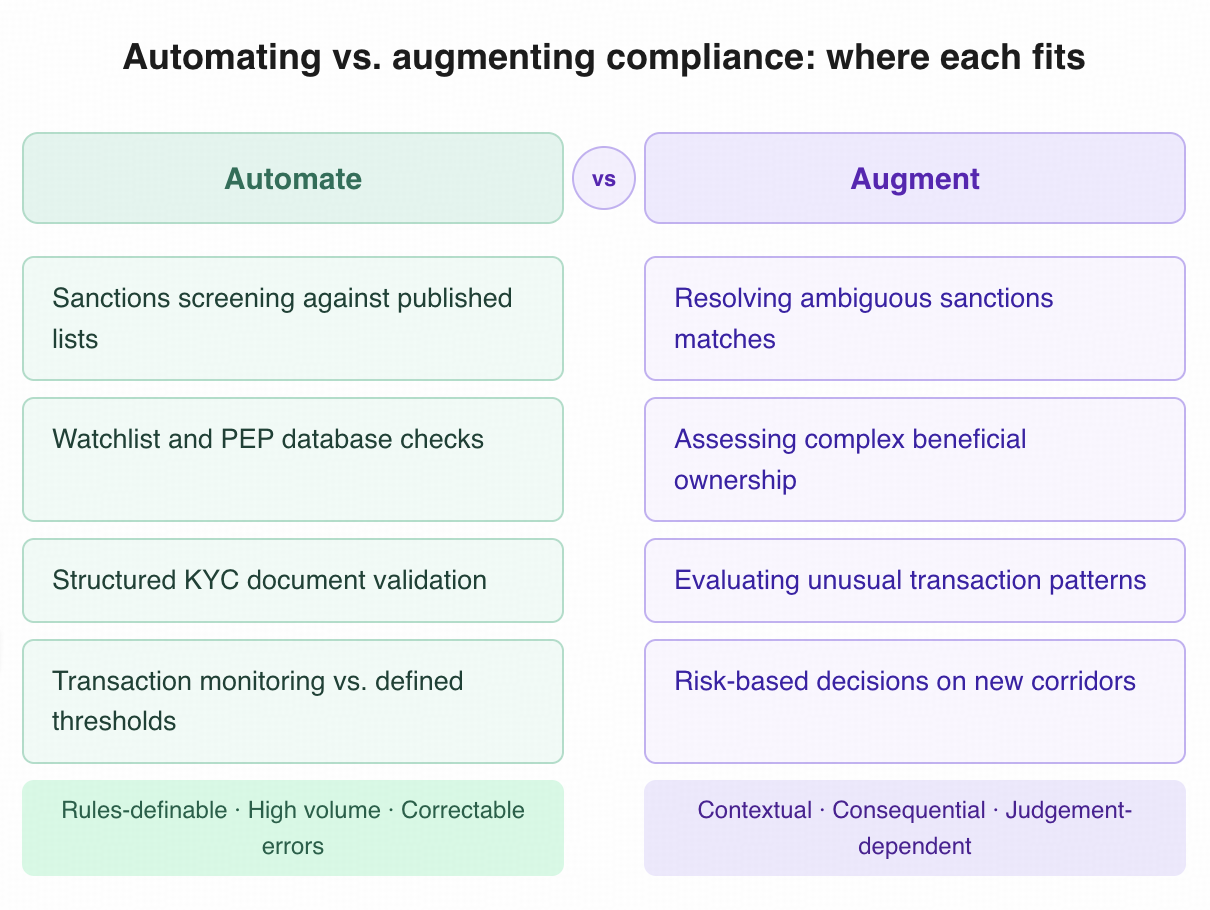
What should be automated
Some compliance tasks are well-suited to full automation because they are high-volume, rules-definable, and the cost of an error is manageable and correctable. These include:
• Sanctions screening against published lists. Matching counterparty names and identifiers against OFAC, UN, EU, and other sanctions lists is a deterministic task. The logic is fixed, the lists are updated regularly, and automated screening at the point of payment initiation is faster and more consistent than manual checking.
• Watchlist and PEP database checks. Politically exposed person screening against standardised databases follows the same logic. The match criteria are defined, and automation handles volume that no manual process could sustain.
• Structured KYC and KYB document validation. Verifying that required identity and business documents have been submitted, that they are within their validity period, and that they match the relevant individual or business record is a process task, not a judgement task. Automation handles it reliably and frees compliance staff from document administration.
• Transaction monitoring against defined thresholds. Flagging transactions that breach pre-defined value thresholds, frequency limits, or corridor restrictions is rules-based work that automation performs more consistently and at greater scale than human review.
The common thread is that these tasks have clear, stable rules, produce binary or near-binary outputs, and do not require contextual interpretation of the specific circumstances of a transaction or counterparty.
What requires human augmentation, not automation
At the other end of the spectrum are compliance decisions that involve genuine contextual interpretation, where the right answer depends on factors that cannot be fully encoded in a rule set and where the consequences of an incorrect decision are significant and potentially irreversible.
These decisions are where augmentation adds the most value:
• Resolving ambiguous sanctions matches
Automated screening generates false positives — names that partially match a sanctioned individual but belong to a legitimate counterparty. Determining whether a match is genuine requires human judgement informed by contextual information that an automated system cannot assemble on its own.
• Assessing complex business and beneficial ownership structures
For cross-border payment counterparties with layered corporate structures, multiple subsidiaries, nominee arrangements or ownership links across jurisdictions, automated KYB tools can help map the entity structure, identify beneficial owners and surface relevant risk signals. The compliance decision, whether the business structure, ownership profile and commercial activity present an acceptable level of risk, still requires human analysis.
• Evaluating unusual transaction patterns in context
Behavioural anomalies flagged by transaction monitoring systems need human review that considers the specific business context of the counterparty: is this spike in transaction volume explained by a known seasonal pattern, a new contract, or something that warrants further investigation?
• Making risk-based decisions on new market entry
Assessing the compliance risk of entering a new payment corridor or onboarding a counterparty in a new jurisdiction involves regulatory interpretation and risk appetite judgement that cannot be delegated to an automated system.
What augmentation looks like in practice
Augmenting a compliance team is not about giving them more dashboards. It is about reducing the time they spend on evidence gathering and data assembly so they can spend more time on the analysis and judgement that only they can provide.
In a well-augmented compliance workflow, the AI layer handles:
• Pre-populating investigation files with relevant business and counterparty information, including KYB records, beneficial ownership structures, transaction history, payment corridors, screening results and prior case notes before a human reviewer opens a case.
• Surfacing the specific data points most relevant to the decision being made, rather than presenting the reviewer with a raw data dump to navigate.
• Flagging pattern-level anomalies across a reviewer's case queue, which draws attention to cases that share characteristics with previously confirmed.
• Generating draft case narratives and audit documentation that the reviewer edits and approves, rather than writing from scratch.
The human reviewer's contribution shifts from assembling information to evaluating it — a shift that both improves decision quality and reduces the time cost of each complex case.
The governance boundary between automation and augmentation
Defining where automation ends and augmentation begins is not a one-time design decision. It requires an ongoing governance process that reviews the boundary as transaction volumes change, as fraud and evasion patterns evolve, and as regulatory expectations develop.
A practical governance framework for this boundary includes:
• A defined list of decision types that are approved for full automation, with documented rationale for why each qualifies — and a separate list of decision types that require human review, with the same documentation
• Regular performance reviews of automated decisions, disaggregated by decision type, corridor, and counterparty segment, to identify where automation is performing as expected and where error rates or false positive rates suggest the boundary needs to move
• An escalation protocol that specifies the conditions under which an automated decision should be surfaced for human review — not just for individual transaction characteristics, but for patterns across multiple decisions
• Audit trail requirements that capture the logic applied by automated systems in a form that can be reviewed by regulators and by internal governance functions — output-only logs are insufficient for either purpose
To get started and partner with a solutions provider that can help your business optimise payments and help you scale both locally and globally, open a SUNRATE account today or contact our sales team.
Share to


When e-commerce scaled in the early 2000s, the infrastructure providers that captured disproportionate value were not the ones with the most merchants or the most consumer relationships. They were the ones that built the payment rails, the fraud detection networks, and the settlement infrastructure that every merchant and every transaction depended on. The value flowed […]

The shift toward autonomous agentic commerce is reshaping how B2B platforms handle value movement, buyer-seller discovery, and transaction execution. While consumer commerce relies on quick UI friction reduction, B2B procurement operates on structured approvals, complex credit arrangements, multi-currency treasury constraints, and rigorous compliance standards. As enterprise AI agents evolve from read-only research tools into active commerce […]
Across enterprise procurement functions, a pattern is emerging that should concern every CFO, CPO, and Head of Compliance paying attention. AI procurement agents — deployed to automate supplier discovery, purchase order generation, invoice matching, and payment initiation — are operating in production environments where the governance frameworks that should define, constrain, and audit their behaviour have not yet been established. This […]
We hope to use cookies to better understand your use of this website. This will help improve your future experience of accessing this website. For detailed information on the use of cookies and how to revoke or manage your consent, please refer to our < privacy policy >. If you click the confirmation button on the right, you will be deemed to have agreed to use cookies.


