
As AI agents move from recommendation engines to autonomous payment operators, businesses face a new trust challenge: proving not only who an agent is, but whether that agent is authorised to make this exact payment at this exact moment.
What remains unsolved is the translation of those proofs into a continuously enforced enterprise permission model — one that reflects current spend limits, approval hierarchies, permitted counterparties, currencies, legal entities, and risk conditions at the moment of execution, not at the moment the mandate was issued.
The distinction is precise and important. Authentication confirms that an agent exists and is legitimate. Most current protocol development addresses the first problem well. The second remains, in most implementations, underbuilt and that gap is what makes agentic payment infrastructure genuinely unsafe to deploy at scale in B2B environments without additional controls in place.
Consumer and B2B payment authorisation rely on many of the same underlying principles, but B2B payments add substantially more complex organisational delegation, approval hierarchies and policy conditions. Consumer payments already involve transaction limits, authentication challenges, merchant category restrictions, recurring payment permissions, and dynamic linking, none of which is truly binary. What distinguishes B2B authorisation is the degree of structured, multi-party delegation involved.
A B2B agent mandate must specify:
• The legal entity the agent represents
• The permitted counterparties it can pay
• The transaction types it can initiate
• Per-transaction and cumulative spend limits
• The validity period of the mandate
• Approval tiers for different transaction values
• Geographic and currency restrictions
• The conditions under which human confirmation is required
Mandate verification confirms that the delegated authority is authentic. Mandate enforcement determines whether that authority still covers the specific transaction at the moment of execution. Both are necessary. Most current protocols address the first; few address the second in full.
The challenge is compounded by the dynamic nature of B2B mandate structures. Spend limits change. Counterparty relationships evolve. Approval thresholds shift with transaction risk and business context. A credential or mandate issued earlier in the relationship may capture a permission state that is materially different from the policy state that should govern a later transaction. And in multi-party arrangements, where a procurement agent must satisfy both the buyer's internal approval policy and a supplier's acceptance conditions, the mandate is not a single document but a set of overlapping requirements that must all be satisfied simultaneously.
The most advanced current protocols each solve part of the mandate problem. AP2's cryptographically signed mandate system provides a chain-of-custody model that is closer to a complete solution than most alternatives. TAP's identity attestation at the HTTP header level addresses agent identity reliably. Mastercard's session-scoped agentic tokens constrain agent authority to defined parameters within a session.
What none of these yet provides is a complete solution for the full B2B permission matrix — particularly:
• Dynamic spend limit enforcement that validates a transaction against the agent's cumulative position across all prior transactions within the current mandate period, not just the per-transaction limit in isolation
• Multi-tier approval workflow integration that pauses execution and routes for human review when a transaction's characteristics — value, counterparty, corridor, or timing — cross a defined threshold
• Real-time mandate validation against live treasury policy rather than against a static credential that reflects policy at issuance time
The absence of a standardised mandate schema — a common structure for expressing what an agent is and is not permitted to do — means businesses implementing agentic payment systems are building proprietary mandate logic that cannot interoperate across providers, rails, or protocol layers. That fragmentation adds cost and creates inconsistency in how mandate enforcement is applied across different parts of the same payment operation.
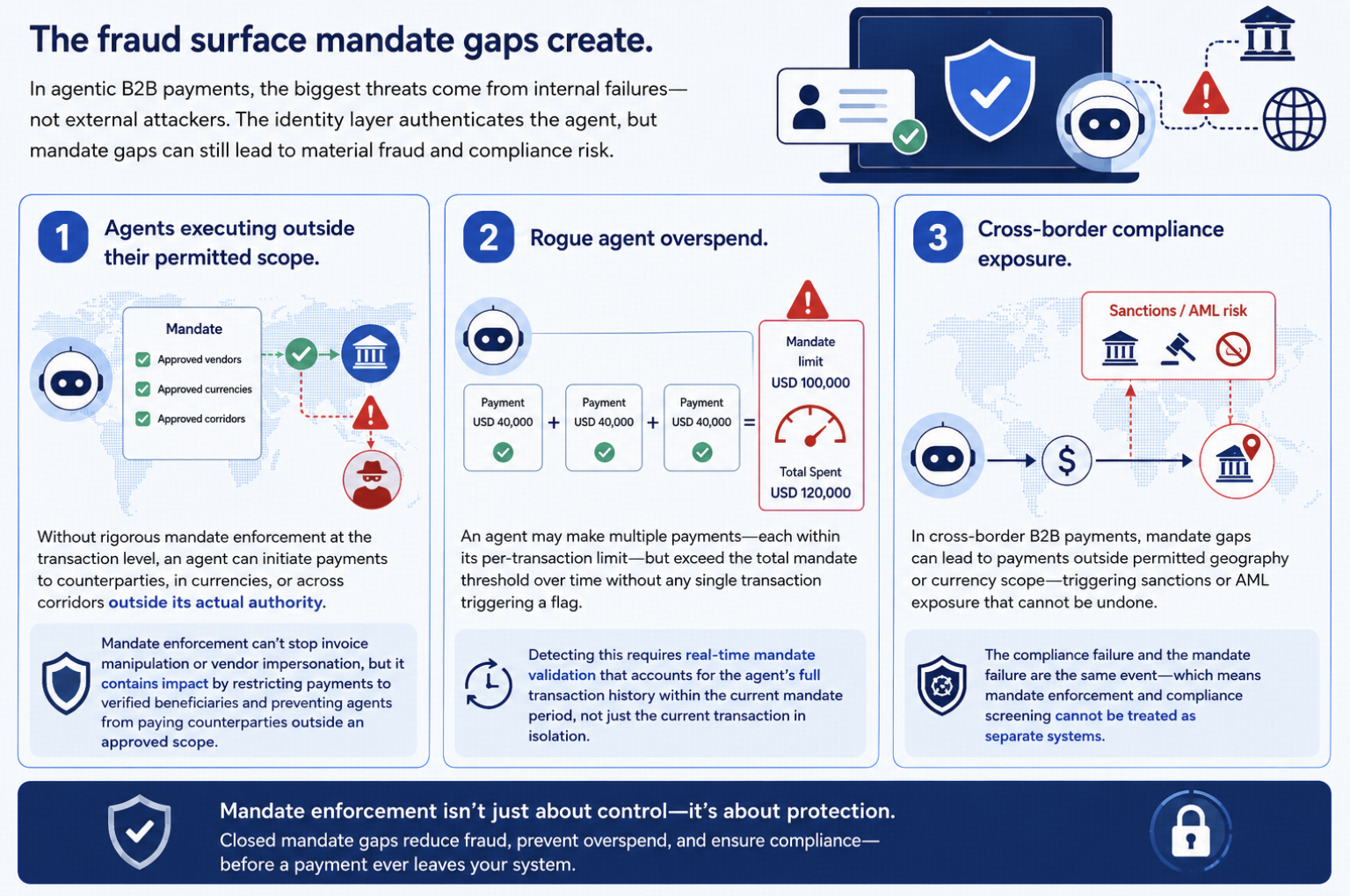
Mandate verification in agentic payments is not a single check. It is a continuously evaluated state that must be resolved against the agent's full permission matrix at the point of every transaction, in real time, accounting for cumulative prior activity within the same mandate period. A complete mandate verification layer must be:
• Dynamic, not credential-based
Validation must draw on the agent's current permission state such as live spend position against cumulative limits, active counterparty approval list and current treasury policy parameters, not a credential that reflects the permission state at issuance.
• Multi-dimensional, not binary
Approval or rejection must reflect the intersection of all relevant mandate dimensions simultaneously: entity, counterparty, transaction type, value, corridor, currency, and timing.
• Embedded in the payment workflow, not applied as a downstream gate
Compliance checks that sit after payment initiation create the same problems as rules-based compliance systems. They catch failures after the instruction has been formed, rather than preventing non-compliant instructions from being formed at all.
• Cryptographically attestable for audit
It is not sufficient to confirm that verification was performed. The specific mandate state at the time of each transaction must be captured in a form that can be reconstructed for regulatory review.
Building this requires integration between the mandate verification layer and internal treasury, ERP, and compliance systems — not as a future integration project, but as a precondition for safe deployment.
• Define the permission matrix before agents operate autonomously: Formalising what each agent may recommend versus execute, which counterparties it can pay, what limits apply, and when human approval is required surfaces the disagreements about risk appetite and approval authority that are far less costly to resolve before deployment than after.
• Evaluate providers on mandate verification architecture, not just identity credentials: Provider and platform selection decisions made now will determine which mandate verification capabilities are available later. Asking explicitly how a provider handles dynamic spend limit enforcement, multi-tier approval workflows, and real-time mandate validation is the right question at procurement stage.
• Build audit logging from day one: As regulatory expectations around AI agent accountability in payments develop, businesses with clearly defined authority models and reconstructable decision records will be better positioned to demonstrate control than those retrofitting documentation after the fact.
The protocols being built right now are solving authentication and identity well. Mandate verification — the layer that confirms an agent's authority is specific, scoped, and current for each transaction — remains the frontier.
The businesses and protocol designers that treat mandate verification as a foundational requirement, not a feature to be added later, will define what trustworthy agentic payment infrastructure looks like for the next decade of B2B commerce. The ones that treat it as someone else's problem to solve will discover, as autonomous payment volumes scale, that the gap between who an agent claims to be and what it is actually permitted to do is where the most significant risks live.
To get started and partner with a solutions provider that can help your business optimise payments and help you scale both locally and globally, open a SUNRATE account today or contact our sales team.
Share to


When e-commerce scaled in the early 2000s, the infrastructure providers that captured disproportionate value were not the ones with the most merchants or the most consumer relationships. They were the ones that built the payment rails, the fraud detection networks, and the settlement infrastructure that every merchant and every transaction depended on. The value flowed […]

The shift toward autonomous agentic commerce is reshaping how B2B platforms handle value movement, buyer-seller discovery, and transaction execution. While consumer commerce relies on quick UI friction reduction, B2B procurement operates on structured approvals, complex credit arrangements, multi-currency treasury constraints, and rigorous compliance standards. As enterprise AI agents evolve from read-only research tools into active commerce […]
Across enterprise procurement functions, a pattern is emerging that should concern every CFO, CPO, and Head of Compliance paying attention. AI procurement agents — deployed to automate supplier discovery, purchase order generation, invoice matching, and payment initiation — are operating in production environments where the governance frameworks that should define, constrain, and audit their behaviour have not yet been established. This […]
We hope to use cookies to better understand your use of this website. This will help improve your future experience of accessing this website. For detailed information on the use of cookies and how to revoke or manage your consent, please refer to our < privacy policy >. If you click the confirmation button on the right, you will be deemed to have agreed to use cookies.


