
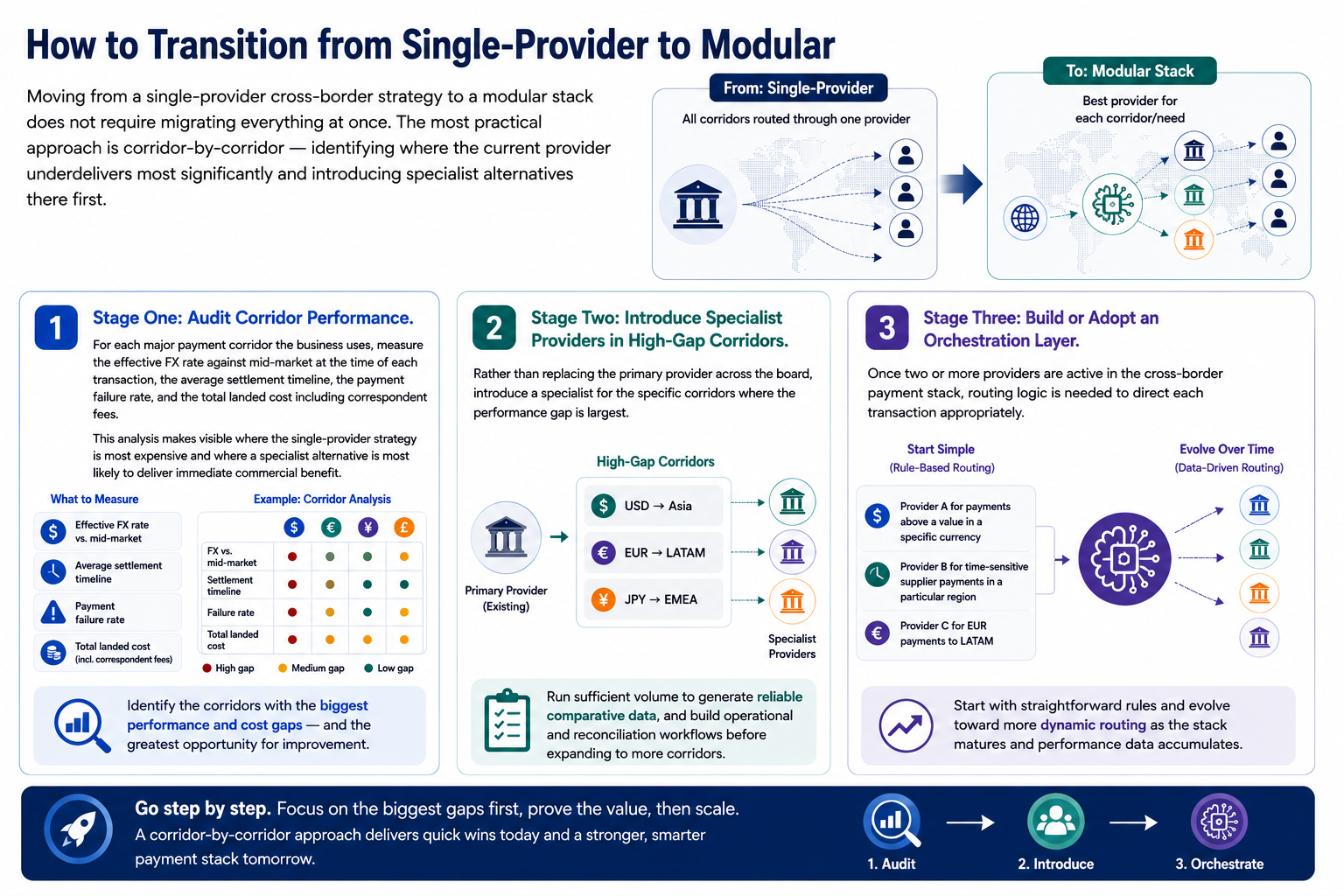
For most of the past two decades, the default approach to cross-border B2B payments was to route everything through a single provider, which usually comprise one correspondent banking chain, one FX relationship, one platform handling payments across every corridor the business needed to reach. That default is increasingly difficult to justify.
What a single-provider cross-border strategy actually costs
The appeal of a single provider for cross-border B2B payments is real: one integration, one compliance relationship, one reconciliation format, one point of escalation when something goes wrong. For businesses with a small number of payment corridors and modest transaction volumes, that simplicity has genuine value.
For businesses operating across multiple markets, currencies, and counterparty types, the trade-offs accumulate differently. No single cross-border payment provider has optimal coverage, pricing, and settlement performance across every corridor a global business needs. In corridors where a provider lacks direct local banking infrastructure, payments route through correspondent chains — adding FX spread at each hop, extending settlement timelines, and reducing the visibility the finance team has into where a payment is and when it will arrive.
The second cost is structural: concentration in a single provider reduces negotiating leverage over time. When all cross-border payment volume flows through one platform, switching costs are high and alternatives are untested. Fee structures, FX pricing, and settlement terms are set against the background of a dependency the business cannot easily exit — and the provider knows it.
What a modular cross-border payment stack looks like
A modular payment stack disaggregates what a single cross-border provider bundles together — separating payment initiation, currency conversion, local settlement, compliance screening, and liquidity management — and sources each from the provider or platform best positioned to deliver it in each corridor.
In practice, a modular cross-border stack typically combines:
• A payment orchestration layer that controls routing logic and determines how each cross-border transaction is directed such as selecting the optimal provider, rail, and currency path at the point of payment based on cost, settlement speed, compliance requirements, and counterparty characteristics
• Corridor-specialist payment providers with strong local banking infrastructure and settlement capability in the specific markets the business trades with most
• Multi-currency account infrastructure that holds working balances in the currencies the business pays and receives most frequently, reducing the number of conversions required and the FX cost accumulated across the payment portfolio
• Integrated compliance and KYB tooling for AML screening, sanctions checking, and business counterparty verification, either embedded in the payment platform or sourced separately and connected via API to ensure consistent coverage across every corridor
The orchestration layer is what makes this a stack rather than simply a collection of providers. Without orchestration, multiple providers create multiple interfaces, multiple data formats, and multiple reconciliation processes that add operational complexity without the corresponding performance benefit. With orchestration, the business controls how cross-border payment volume is allocated and can rebalance dynamically based on corridor performance.
Why the shift is accelerating in 2026
Three structural changes have made modular cross-border payment stacks more practical and more commercially compelling than they were even three years ago.
API-first payment infrastructure has lowered the integration cost
Modern cross-border payment providers expose their settlement, FX, and compliance capabilities through well-documented APIs that connect to existing ERP and treasury management systems without the deep technical coupling that characterised legacy integrations. Adding a corridor-specialist provider or replacing an underperforming one is now a weeks-long integration project rather than a months-long infrastructure programme.
The specialist provider market has reached genuine maturity
The ecosystem of cross-border payment providers with deep local market infrastructure, specialist FX platforms, virtual card issuers, and compliance tooling vendors has developed to the point where businesses can source genuinely differentiated capability for specific corridors and payment types. The performance gap between a corridor specialist and a generalist provider operating in the same market has widened significantly in the specialist's favour across settlement speed, local payment method support, and FX pricing.
Cross-border payment data has become a strategic asset
Businesses that route all international payment volume through a single provider often find that their corridor performance data, FX execution history, and counterparty payment records sit in the provider's systems rather than their own. A modular stack, controlled through a business-owned orchestration layer, keeps that data accessible for treasury management, cash flow forecasting, and supplier relationship decisions.
What to watch for
Modular cross-border payment stacks introduce management overhead that businesses should prepare for before beginning the transition.
Reconciliation complexity scales with the number of providers
Each provider generates transaction data in its own format and on its own settlement timeline. Without a consolidated reconciliation layer — ideally connected to the business's ERP or treasury management system — the finance team bears the burden of matching records across multiple systems, which can erode the cost savings the modular stack was designed to capture.
Compliance coverage must be mapped explicitly across every corridor
A modular stack does not automatically inherit the compliance infrastructure of a primary provider. AML screening, sanctions checking, and KYB obligations must be explicitly covered for every payment flow, regardless of which provider processes it. Mapping compliance coverage before volume flows through a new provider is a governance requirement, not an optional step.
Provider concentration risk shifts rather than disappears
A modular stack that distributes cross-border payment volume across multiple providers reduces dependency on any single one, but introduces the risk of over-reliance on specific providers for specific corridors. Regularly reviewing provider concentration by corridor and maintaining at least one tested alternative in each major market, keeps the resilience benefits of the modular approach intact over time.
The future ahead
Single-provider cross-border payment strategies are not going away entirely. For businesses with a small number of trading corridors, low transaction volumes, or strong existing provider relationships, the simplicity of a single iintegration retains genuine appeal.
What is changing is the assumption that a single provider should be the default for businesses operating complex, multi-corridor cross-border payment flows. The combination of a maturing specialist provider market, lower API integration costs, and growing awareness of the performance and cost gaps that single-provider concentration creates is shifting the calculus — corridor by corridor, finance team by finance team — toward a modular approach that optimises for outcomes rather than operational convenience.
To get started and partner with a solutions provider that can help your business optimise payments and help you scale both locally and globally, open a SUNRATE account today or contact our sales team.
Share to



When e-commerce scaled in the early 2000s, the infrastructure providers that captured disproportionate value were not the ones with the most merchants or the most consumer relationships. They were the ones that built the payment rails, the fraud detection networks, and the settlement infrastructure that every merchant and every transaction depended on. The value flowed […]


The shift toward autonomous agentic commerce is reshaping how B2B platforms handle value movement, buyer-seller discovery, and transaction execution. While consumer commerce relies on quick UI friction reduction, B2B procurement operates on structured approvals, complex credit arrangements, multi-currency treasury constraints, and rigorous compliance standards. As enterprise AI agents evolve from read-only research tools into active commerce […]
Across enterprise procurement functions, a pattern is emerging that should concern every CFO, CPO, and Head of Compliance paying attention. AI procurement agents — deployed to automate supplier discovery, purchase order generation, invoice matching, and payment initiation — are operating in production environments where the governance frameworks that should define, constrain, and audit their behaviour have not yet been established. This […]
We hope to use cookies to better understand your use of this website. This will help improve your future experience of accessing this website. For detailed information on the use of cookies and how to revoke or manage your consent, please refer to our < privacy policy >. If you click the confirmation button on the right, you will be deemed to have agreed to use cookies.


