
The businesses pulling ahead in global supply chains are not always the ones with the largest procurement budgets. Increasingly, they are the ones that pay faster, more predictably, and in the currency their suppliers prefer. Payment terms have quietly become a competitive differentiator and in cross-border B2B trade, the gap between businesses that understand this and those that do not is widening.
Why payment terms matter more than most finance teams realise
Payment terms have traditionally been viewed as a financial obligation — a liability to be managed, extended where possible, and standardised across the supplier base for operational convenience. That framing made sense when supply chains were stable, supplier alternatives were abundant, and the cost of capital was low enough that the timing of payment did not significantly affect supplier behaviour.
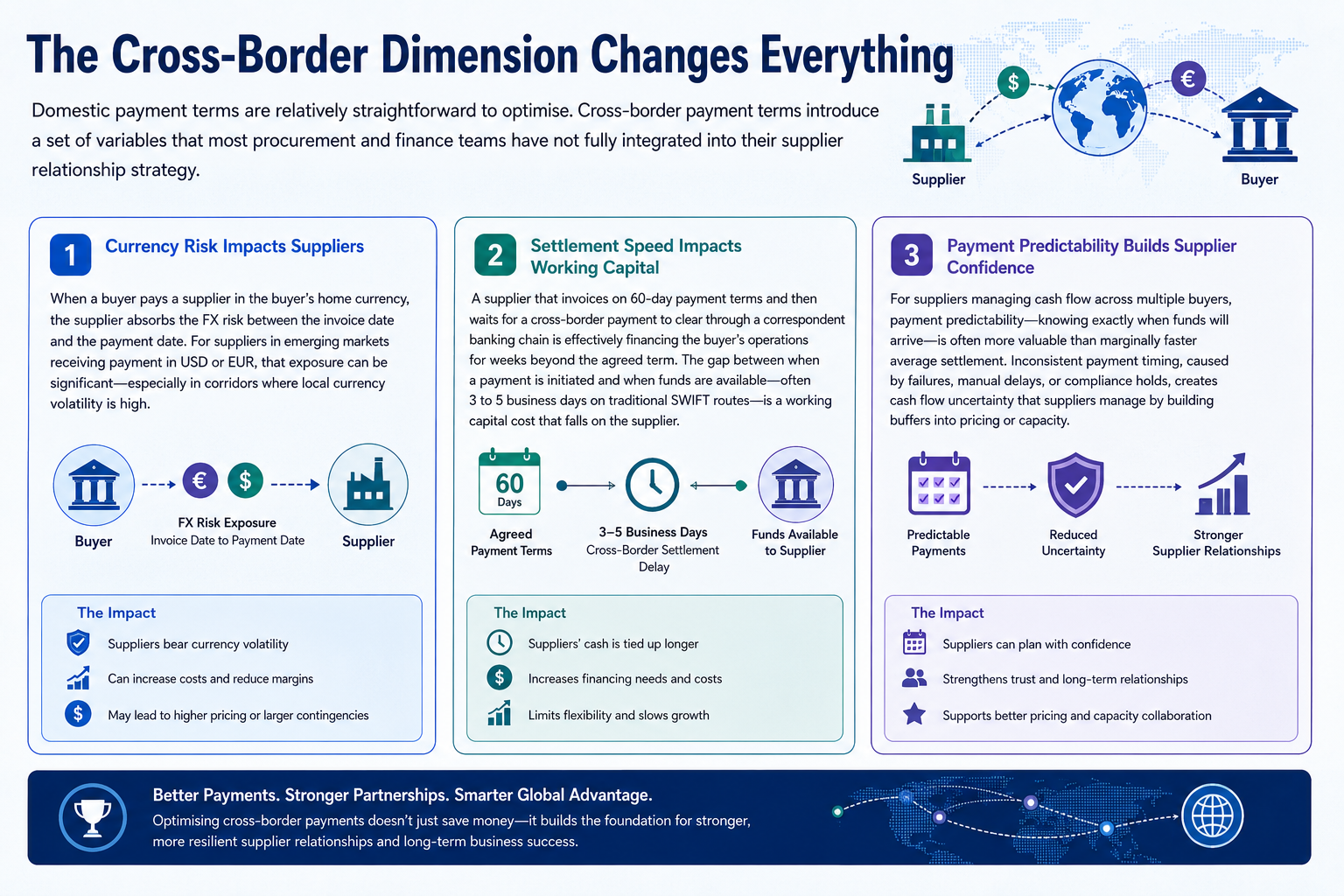
None of those conditions reliably hold today. Supply chains are more concentrated, key supplier relationships are harder to replace, and the cost of capital for smaller suppliers, particularly those in emerging markets operating in less liquid currency environments, has risen substantially. In this context, payment terms are no longer just a financial arrangement. They are a signal of how much a buyer values the relationship, and a practical determinant of whether a supplier can afford to prioritise that buyer's orders over others.
How leading businesses are using payment strategy as a competitive lever
The businesses using payment terms most effectively as a competitive weapon are doing so across three dimensions simultaneously.
Offering early payment in exchange for pricing advantages
Dynamic discounting, where suppliers can choose to receive payment earlier than the standard term in exchange for a modest discount, is well established in domestic supply chains but underused in cross-border contexts. For suppliers facing high local borrowing costs or currency volatility, the effective return on early payment can be significantly higher than what they could achieve through local financing. Buyers that offer credible early payment capability in cross-border corridors are accessing a form of supplier financing that benefits both parties.
Using payment currency as a relationship differentiator
Offering to pay in a supplier's local currency or in a currency that minimises their FX exposure, requires multi-currency payment infrastructure but delivers a tangible benefit that invoice payment terms alone cannot. In markets where suppliers routinely absorb significant FX spread on USD-denominated payments, a buyer that can settle in local currency is reducing the supplier's effective cost of doing business with them. That difference shows up in supplier pricing over time and in how discretionary capacity is allocated when supply is constrained.
Building payment reliability into supplier SLAs
Leading procurement teams are beginning to treat payment performance including settlement success rates, payment timeline adherence and failure rates, as a measurable element of the supplier relationship, alongside quality, lead time, and pricing. Communicating payment performance data to strategic suppliers (demonstrating that payments arrive on time, in full, with predictable timing) builds the kind of trust that influences supplier investment decisions, production prioritisation, and commercial flexibility in ways that payment terms alone cannot.
The infrastructure requirement
Using payment terms as a competitive weapon in cross-border B2B trade requires payment infrastructure that most businesses have not yet built. The gap is not always obvious — many finance teams believe their cross-border payment capability is adequate because payments generally arrive eventually. What they are not measuring is the gap between their payment performance and what is now commercially achievable.
The infrastructure requirements are specific:
• Multi-currency settlement capabilitythat allows payments to be made in the supplier's preferred currency without requiring the buyer to hold exotic currency balances. Thisare handled through a payment platform with local currency liquidity in the relevant corridors.
• Fast settlement rails in key corridors that reduce the time between payment initiation and funds availability from the three-to-five-day correspondent banking standard to same-day or next-day settlement where local infrastructure supports it.
• High straight-through processing rates that minimise payment failures and manual intervention — because a payment that fails and requires reprocessing negates the settlement speed advantage and creates exactly the unpredictability that erodes supplier confidence.
• Payment status visibility that allows finance teams to confirm settlement and communicate it to suppliers accurately, removing the uncertainty that characterises correspondent banking chains where payment status is opaque between hops.
The supplier perspective finance teams should internalise
It is worth stepping back from the buyer's perspective and considering what a strategic supplier is actually evaluating when they assess their relationship with a buyer. Price matters. Volume matters. Forecast accuracy matters. However, the payment relationship such as how reliably the buyer pays, how quickly funds arrive, how much currency risk the supplier absorbs, and how much working capital the payment terms effectively require the supplier to provide, is a material element of the commercial relationship that is rarely discussed explicitly and almost never measured systematically by either party.
Suppliers allocate their best capacity, their most competitive pricing, and their greatest commercial flexibility to the buyers they most want to retain. Payment performance is increasingly one of the variables that shapes those allocation decisions — particularly in industries where key suppliers have more options than buyers recognise.
A practical starting point
For finance and procurement teams that want to move payment terms from a compliance function to a competitive strategy, the starting point is measurement. Auditing current cross-border payment performance including settlement timelines by corridor, payment failure rates, currency conversion costs and supplier-reported payment experience, creates the baseline from which improvement is visible and the business case for infrastructure investment can be made.
The businesses that build this capability now, while it remains a differentiator, will find it increasingly difficult for competitors to replicate — because the infrastructure, the supplier relationships, and the payment performance data that underpins them compound in value over time.
To get started and partner with a solutions provider that can help your business optimise payments and help you scale both locally and globally, open a SUNRATE account today or contact our sales team.
Share to



When e-commerce scaled in the early 2000s, the infrastructure providers that captured disproportionate value were not the ones with the most merchants or the most consumer relationships. They were the ones that built the payment rails, the fraud detection networks, and the settlement infrastructure that every merchant and every transaction depended on. The value flowed […]


The shift toward autonomous agentic commerce is reshaping how B2B platforms handle value movement, buyer-seller discovery, and transaction execution. While consumer commerce relies on quick UI friction reduction, B2B procurement operates on structured approvals, complex credit arrangements, multi-currency treasury constraints, and rigorous compliance standards. As enterprise AI agents evolve from read-only research tools into active commerce […]

Across enterprise procurement functions, a pattern is emerging that should concern every CFO, CPO, and Head of Compliance paying attention. AI procurement agents — deployed to automate supplier discovery, purchase order generation, invoice matching, and payment initiation — are operating in production environments where the governance frameworks that should define, constrain, and audit their behaviour have not yet been established. This […]
We hope to use cookies to better understand your use of this website. This will help improve your future experience of accessing this website. For detailed information on the use of cookies and how to revoke or manage your consent, please refer to our < privacy policy >. If you click the confirmation button on the right, you will be deemed to have agreed to use cookies.


